

Victoria Masters Soccer League (VMSL) Edmonton
League Rules & Bylaws
VMSL League Policy — Please Review Before You Register Your Team
League Discretion on Team Acceptance
- Rule: VMSL reserves the right to accept or reject any team’s application at any time, for any reason, without providing notice or explanation.
- Effect: Participation in past seasons does not guarantee acceptance for future seasons. All returning teams must reapply.
- Observation: Entry into the league is entirely at the discretion of VMSL. Teams should apply with the understanding that acceptance is not automatic.
- Deposit Requirement:
- A $1,000 deposit must accompany all registrations. Registration is not considered valid or complete until the deposit has been received.
Scheduling Policy — No Reschedules
- Rule: There are no reschedules for tournaments, holidays, cultural events, or player availability.
- Effect: Teams are responsible for ensuring they can meet all scheduled match obligations even when conflicts arise.
- Observation:
- Teams with multi-division players must manage overlap on their own.
- Observation:
- Teams should plan their season based on full availability and depth, since personal and external scheduling conflicts will not be accommodated.
Scheduling Policy — No Special Requests
Rule:
No special requests will be considered for preferred match times or dates.
Policy:
- Teams must be prepared to play at any assigned time slot and field location.
- If players participate in multiple divisions and scheduling conflicts occur, no rescheduling will be permitted.
- All posted schedules are final, unless VMSL determines that internal adjustments to games, dates, times, or scheduling are necessary.
Rationale:
VMSL schedules are designed to ensure fairness across the entire league, rather than accommodate individual team preferences. Field bookings, match times, and referees are secured prior to the start of the season, and the league is financially committed to these arrangements. As a result, full payment obligations remain regardless of whether a team is able to play, making rescheduling not feasible.
Bye Weeks and Final Schedules
- Rule: Bye weeks only apply if there is an odd number of teams in a division. Schedules are final and distributed evenly in terms of fields and time slots.
- Effect: Teams should not expect bye weeks, schedule adjustments, or exceptions once schedules are posted.
- Observation:
- Once the schedule is released, the league expects complete compliance and flexibility from all teams.
Disciplinary Authority
VMSL has the authority to bar teams, players, or officials from scheduled games.
This can occur if, in their judgment, a person or team has:
- Violated the laws of the game.
- Broken VMSL rules, regulations, by-laws, or constitution.
- Engaged in misconduct that harms the reputation of the league or the game.
Grounds for discipline include:
- Bylaw breaches.
- Detrimental conduct toward the VMSL.
- Any behavior that brings the game into disrepute.
Misconduct is broadly defined and may involve actions on or off the field, and can be reported by:
- A VMSL board member.
- Participants in the game.
- Even spectators.
Team Commitment Reminder
By registering, teams acknowledge that:
-
League acceptance is not guaranteed, even for returning teams.
-
Schedules will not be adjusted for conflicts.
-
Match dates/times are assigned without special requests.
-
Full compliance is expected once schedules are posted.
VMSL Business Hours & Communication Policy
- All VMSL business activities are to be conducted during regular business hours:
- Monday to Friday
- 9:00 a.m. – 5:00 p.m.
- Communications received outside of these hours, including evenings and weekends, will not be monitored or addressed until the next business day.
- Teams and players are expected to adhere to this schedule for all VMSL-related communications and operations.
Table of Contents
-
League Identity & Authority
-
Membership & Affiliation
-
Governance & Administration
-
Team Meetings
-
Team Fees & Financial Rules
-
Team Entry & Club Administration
-
Player Registration & Age Eligibility
-
Transfers & Player Movement
-
Laws of the Game & Match Standards
-
Match Day Operations
-
Competition Format & Standings
-
Discipline, Misconduct & Sanctions
-
Protests, Complaints & Appeals
-
Referees & Match Officials
-
Risk Management & Safe Sport
-
Teams & VMSL Communications, Privacy & Records
-
Amendments, Interpretation & Enforcement
-
Video Camera Review & Game Footage
(1) League Identity & Authority
1.1 Name of the League
VMSL (Victoria Masters Soccer League)
1.2 League Jurisdiction (Edmonton Region)
The League shall operate within the geographic area of Edmonton and surrounding region, as determined by VMSL Officials from time to time.
1.3 Objectives and Purpose
The purposes of the League are:
(a) To organize, govern, and operate soccer competitions for its Members.
(b) To promote the sport of soccer and participation in a safe and respectful environment.
(c) To establish standards, rules, and discipline for league play.
(d) To act in the best interests of the League and its Members.
1.4 Games and Competitions — Scheduling and Participation Policy
(a) Scheduling Authority
- The VMSL Office is responsible for establishing the schedule for all VMSL games, including game dates, times, and venues.
(b) Notice of Schedules
- All schedules shall be published on the official VMSL website. Publication on the website constitutes sufficient notice to all teams.
(c) Schedule Changes and Requests
- The VMSL will not accept scheduling requests for:
-
specific dates or times off;
-
switching from large fields to small fields.
The VMSL will make reasonable efforts to distribute game dates and times fairly across teams and divisions.
(d) Conflicts and Finality of Posted Schedules
- No exceptions will be made where players are registered in multiple divisions and game times overlap.
- The schedule as posted on the official VMSL website is final.
Summary
The VMSL maintains a strict scheduling policy and does not grant exceptions to posted schedules or player conflict situations.
One note: your last line about “strict participation standards” and “zero tolerance for infractions” is stronger than what the text itself says. The policy you pasted is clearly strict on scheduling and conflicts, but it does not expressly address all participation standards or infractions.
1.5 Admission and Spectator Control
The VMSL reserves the right to grant or refuse admission to any VMSL game to any person whose presence may be considered detrimental to the conduct of the match or the best interests of the league.
1.6 Admission Fees
The VMSL reserves the right to charge admission fees for any VMSL game at its discretion.
1.7 Outstanding Financial Obligations and Eligibility Review
Teams with outstanding amounts exceeding $500 unpaid for 90 days or more may be subject to review regarding eligibility to participate.
VMSL may suspend such teams until all outstanding dues are paid in full.
1.8 Good Standing Requirement for ASA Competition
To be eligible for ASA competition, a team must remain in good standing with VMSL, including compliance with all financial and administrative obligations.
1.9 Governing Authority
The League shall be governed by:
(a) These Bylaws
(b) League Rules and Regulations adopted by the Board
(c) The Laws of the Game (IFAB)
(d) Applicable policies and requirements of recognized governing bodies
1.10 Definitions and Interpretations
In these Bylaws, words importing the singular include the plural and vice versa.
Key definitions include:
-
Board – Board of Directors of the League
-
Member – Team, club, or organization admitted to membership
-
Player – Individual registered to a Member
-
Season – Competition period defined by the Board
-
Team Official – Manager, coach, trainer, or authorized team representative
1.11 League Policies Superseding Rules
Where these Bylaws conflict with League Rules and Regulations:
- These Bylaws prevail.
- Governing body rules (ASA / CSA) prevail over League Rules where applicable.
(2) Membership & Affiliation
2.1 Eligibility for Membership
Membership shall be available to teams, clubs, or organizations meeting League eligibility criteria and in good standing with the League.
Observation:
Past performance, conduct, and disciplinary record may influence eligibility.
2.2 Admission
Membership shall be granted upon:
- Completion of registration documentation
- Payment of all fees and deposits
- Approval by VMSL or its designate
2.3 Member Rights & Responsibilities
Members shall:
- Comply with all bylaws and rules
- Ensure players and officials are registered
- Conduct themselves according to league standards
- Be responsible for the conduct of players, officials, and spectators
2.4 Good Standing Requirements
- A Member shall be considered in good standing only when all financial and administrative obligations are fulfilled.
2.5 Suspension / Termination of Membership
VMSL may suspend or terminate membership where a Member is proven to have violated rules or engaged in misconduct.
Disciplinary actions may include:
- Suspension
- Expulsion
- Fines
- Additional sanctions as determined by VMSL
2.6 Non-Discrimination and Inclusion Policy
The League shall not tolerate discrimination, harassment, or abusive conduct based on:
- Race
- Nationality
- Ethnicity
- Religion
- Gender identity
- Sexual orientation
- Disability
- Any protected ground
2.7 Mandatory League Compliance Notice
VMSL has zero tolerance for teams that disrupt league operations.
Teams that frequently:
- Forfeit games
- Play short of players
- Fail to meet fee obligations
May have their games scheduled on the 8v8 small field instead of the regular 10v10 large field.
Continued non-compliance may result in termination of future participation.
Compliance is not optional.
(3) Governance & Administration
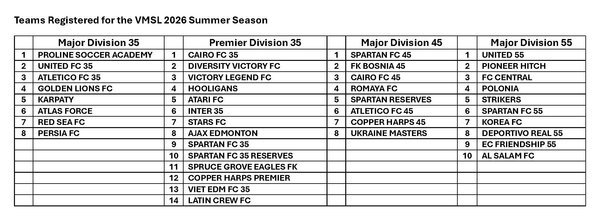
VMSL 2026 Summer Season
Season Dates by Division
- Major Division 35 - Starts on April 27th and ends on October 5th.
- Premier Division 35 - Starts on May 5th and ends on September 29th.
- Major Division 45 - Starts on April 23rd and ends on October 9th.
- Major Division 55 - Starts on April 23rd and ends on October 9th.
Non-Scheduling Dates
No games will be scheduled during the following holiday periods:
-
April 3rd – Good Friday
-
May 14th, 15th, 16th, 17th and 18th – Victoria Day
-
July 1st, 2nd, 3rd – Canada Day
-
July 30th, 31st
-
August 1, 2, 3rd (Monday) – Civic Holiday
-
September 3rd, 4th, 5th, 6th, 7th (Monday) – Labour Day
Game Nights and Starting Times
Monday
Start Times: 8:00 PM / 9:10 PM and 7:20 PM / 8:30 PM / 9:40 PM
- 3 games on the 8v8 field - 7:20 PM / 8:30 PM / 9:40 PM
- 2 games on the 10v10 field - 8:0 PM / 9:10 PM
Tuesday
Start Times: 7:35 PM / 8:45 PM / 9:55 PM
-
3 games on the 8v8 field - 7:35 PM / 8:45 PM / 9:55 PM
-
3 games on the 10v10 field - 7:35 PM / 8:45 PM / 9:55 PM
Thursday
Start Times: 8:00 PM / 9:10 PM
-
2 game on the 8v8 field - 8:00 PM / 9:10 PM
-
2 games on the 10v10 field - 8:00 PM / 9:10 PM
Friday
Start Times: 7:30 PM / 8:40 PM / 9:50 PM
-
2 games on the 8v8 field - 7:30 PM / 8:40 PM
-
3 games on the 10v10 field - 7:30 PM / 8:40 PM / 9:50 PM
Note:
Major Division 45 and 55 teams may play on Thursdays or Fridays.
3.1 League Structure (Divisions and Age Groups)
The League shall be organized into divisions and competitions as determined annually by VMSL.
VMSL Divisional Format
-
Please be advised that the competition format described herein may be amended and/or implemented differently between the Summer and Winter seasons at the discretion of VMSL.
-
The number of games in each division will depend on the number of teams registered.
-
The league champion will be determined based on total points accumulated after the round robin(s) or group stages as described below.
(A) VMSL Divisional Format — 6 Teams
Regular Season Champion
Double Round Robin (2 Rounds)
-
Each team plays every other team twice
-
Each team has 5 opponents
-
5 opponents × 2 games = 10 regular-season games per team
Regular Season Champion:
The team with the best record after 10 games
Playoffs Champion
Double Round Robin (2 Rounds)
-
All 6 teams qualify for playoffs
-
Each team plays every other team twice
-
5 opponents × 2 games = 10 playoff games per team
Playoff Champion:
The team with the best playoff record after 10 games
Total Matches per Team
-
10 Regular Season Games
-
10 Playoff Games
Total: 20 Games per Team
(B) VMSL Divisional Format — 8 Teams
Regular Season
-
8 teams compete in a double round-robin format
-
Each team plays every other team twice
-
Total games per team: 14
League Champion:
The team finishing 1st overall after the regular season
Playoffs – Champions Cup
-
All 8 teams advance
-
Single round-robin playoff format
-
Each team plays every other team once
-
Total games per team: 7
Champions Cup Winner:
The team finishing 1st overall in the playoff round robin
Note:
VMSL reserves the right, in its sole and absolute discretion, to change, amend, or revise this competition format at any time prior to the commencement of the season, without prior notice.
(C) VMSL Divisional Format — 10 Teams
Regular Season
-
10 teams compete in a double round-robin format
-
Each team plays every other team twice
-
Total games per team: 18
(9 opponents × 2 games each)
League Champion:
The team finishing 1st overall after the regular season
Playoffs – Champions Cup
Teams split into 2 groups of 5
-
Group A: Top 5 teams (based on regular season standings)
-
Group B: Bottom 5 teams
Group Play Format
Format: 1 Round Robin
-
Each team plays every other team in their group once
-
Games per team: 4
Total Matches per Team
-
Regular Season: 18
-
Playoffs Group Stage: 4
Total per Team: 22 Games
Playoffs Champions
-
The team with the highest number of points in Group A shall be declared Group A Playoffs Champion
-
The team with the highest number of points in Group B shall be declared Group B Playoffs Champion
No inter-group or final championship match shall be played.
(D) VMSL Divisional Format — 12 Teams
Regular Season
-
12 teams compete in a single round-robin format
-
Each team plays every other team once
-
Total games per team: 11
League Champion:
Team finishing 1st overall after the regular season
Playoffs – Champions Cup
Teams split into 2 groups of 6
-
Group A: Top 6 teams
-
Group B: Bottom 6 teams
Group Play Format
Format: 2 Round Robin
-
Each team plays every other team twice
-
Games per team: 10
Total Matches per Team
-
Regular Season: 11
-
Playoffs Group Stage: 10
Total per team: 21
Playoffs Champions
-
Highest points in Group A = Group A Champion
-
Highest points in Group B = Group B Champion
No inter-group championship match.
(E) VMSL Divisional Format — 14 Teams
Regular Season
-
14 teams compete in a single round-robin format
-
Each team plays every other team once
-
Total games per team: 13
League Champion:
Team finishing 1st overall after regular season
Playoffs – Champions Cup
Teams split into 2 groups
-
Group A: Top 7 teams (Seeds 1–7)
-
Group B: Bottom 7 teams (Seeds 8–14)
Group Play Format
-
Each group plays a single round robin
-
Each team plays 6 games
Total Matches per Team
-
Regular Season: 13
-
Playoffs Group Stage: 6
Total per team: 19
Playoffs Champions
-
Highest points in Group A = Group A Champion
-
Highest points in Group B = Group B Champion
No inter-group championship match.
(F) VMSL Divisional Format — 16 Teams
Regular Season
-
16 teams compete in a single round-robin format
-
Each team plays every other team once
-
Total games per team: 15
League Champion:
Team finishing 1st overall after regular season
Playoffs – Champions Cup
Teams split into 2 groups of 8
-
Group A: Top 8 teams
-
Group B: Bottom 8 teams
Group Play Format
Format: 1 Round Robin
-
Each team plays every other team in their group once
-
Games per team: 7
Total Matches per Team
-
Regular Season: 15
-
Playoffs Group Stage: 7
Total per team: 22
Playoffs Champions
-
Highest points in Group A = Group A Champion
-
Highest points in Group B = Group B Champion
No inter-group championship match shall be played.
Note:
VMSL reserves the right, in its sole and absolute discretion, to change, amend, or revise this competition format at any time prior to the commencement of the season, without prior notice.
3.2 League and Game Officials
- All Game Officials shall be under the jurisdiction of the VMSL.
- The VMSL (including the Referee Coordinator) reserves the right to remove any Game Official from the official list at its discretion.
- Game Officials for each match shall be appointed by the VMSL Referee Coordinator (or designate) and shall be selected from the official list of referees.
- The VMSL shall assign Game Officials for all scheduled matches. However, if due to unforeseen circumstances an appointed Game Official from the official list is unable to act, the team captains may agree—by signing the game sheets—to appoint another registered and certified Game Official to officiate for all or part of the match.
- If a Game Official does not appear for a scheduled match and the teams cannot agree upon an alternate registered and certified Game Official to officiate, the teams must notify the VMSL. The match may be rescheduled if possible. If rescheduling is not possible, the match shall be recorded as a 0–0 tie.
- Game Officials shall receive fees as established by the VMSL in respect of matches officiated by them.
3.3 Officers
The League shall have officers including, at minimum: President, Vice-President.
3.4 Committees (Discipline & Appeals)
VMSL may establish committees, including but not limited to:
(a) Discipline Committee;
(c) Appeals Committee.
3.5 Conflict of Interest
All League Officials and Discipline committee members shall disclose any actual or perceived conflict of interest. The League may require recusal from discussion and voting where appropriate.
3.6 Code of Ethics
All League officials, Members, Players, Team Officials, and referees shall comply with League ethical standards and codes of conduct.
3.7 Authority to Issue Policies and Regulations
The League (VMSL) may adopt, amend, or repeal League Rules and Regulations as required to manage league operations, provided they are consistent with these Bylaws.
(4) Team Meetings
4.1 Annual General Meeting
The League shall hold an Annual General Meeting (AGM) within the timeframe determined by VMSL prior to each season. All teams are encouraged to attend, or to send a representative, to remain informed of any rule changes and to address any concerns affecting their team.
4.2 Special Meetings
Special meetings may be called by VMSL.
4.3 Notice
Notice of meetings shall be provided not less than fourteen (7) days prior to the meeting date unless an emergency meeting is required.
(5) Team fees & Financial Rules for Payment
5.1 League Fees
$1,000 deposit must accompany all registrations. Registration is not considered valid or complete until the deposit has been received.
5.2 Summer Season Fees $4,000
- $1,000 deposit — due Mar 1st.
- $1,000 second payment — due May 15th (+$100 late fee if missed)
- $1,000 third payment — due Jun 15th (+$100 late fee if missed)
- $1,000 final payment — due Jul 15th (+$100 late fee if missed)
5.3 Winter season Fees $4,200
- $1,000 team deposit — due Sept 15th or at the General Team meeting.
- $1,000 second payment — due Oct 15th (+$100 late fee if missed)
- $1,100 third payment — due Nov 15th (+$100 late fee if missed)
- $1,100 final payment — due Dec 15th (+$100 late fee if missed)
5.4 Late Fee Policy
- $100 per missed due date (for second/third/final payments)
- $300 additional fee if the full balance is not paid by the season deadline.
5.5 How to pay.
- E-transfer: payment@vmsl.ca
- Cheques payable to Victoria Master’s Soccer League
5.6 Overdue Payment Fee
An overdue payment fee shall be assessed on any invoice not paid in full by its stated due date (“Overdue Balance”). Any Overdue Balance shall be subject to an overdue payment fee per month, which shall be charged monthly and shall continue to accrue until the Overdue Balance is paid in full. Payment of the overdue payment fee does not relieve the team of its obligation to pay the outstanding Team Fees.
5.7 Suspension and Expulsion for Non-Payment
Failure to pay all current VMSL Team Fees by the applicable deadline constitutes a material breach of league requirements. Any team that fails to pay in full by the deadline may, at the sole discretion of VMSL, be subject to immediate disciplinary action, including but not limited to:
- Immediate suspension from all VMSL activities.
- Ineligibility to participate in any scheduled league games, matches, or events in any division; and/or
- Expulsion from the league.
For greater certainty, where a team is suspended or expelled for non-payment, all coaches, managers, and players registered to that team shall be ineligible to participate in any VMSL-sanctioned games or activities in any division until the outstanding Team Fees are paid in full and any suspension is formally lifted by VMSL.
5.8 No Exceptions
No exceptions, extensions, waivers, or accommodations shall be granted in respect of overdue payment fees, suspension, or expulsion for non-payment. VMSL reserves the right to enforce this policy strictly in all circumstances.
5.9 Ineligibility for Future Participation
Any team, coach, manager, or player associated with an unpaid account may be deemed ineligible for future participation in any VMSL league, division, competition, or program until all amounts owing are paid in full and may remain ineligible thereafter as determined by VMSL in its sole discretion.
5.10 Awards, Recognition, and Reassignment of Titles
(a) Eligibility for Awards
Any team that wins League Champions and/or the Champions Cup but is not fully paid and in good standing at the time of awarding shall be ineligible to receive medals, trophies, prizes, or official recognition until all Team Fees are paid in full.
(b) Reassignment of Titles
If full payment is not received within a timeframe determined by VMSL, the league reserves the right, in its sole discretion, to:
-
Withhold awards indefinitely; and/or
-
Reassign recognition, trophies, and titles to the runner-up team, which may then be officially recognized as the League Champions and/or Champions Cup winner.
5.11 VMSL Reservation of Rights
VMSL reserves the right to take any additional action permitted under league rules, including the right to recover outstanding amounts owed by any lawful means.
VMSL’s failure to enforce any provision of this policy in any instance shall not constitute a waiver of its right to enforce the policy in the future.
5.12 Payment Deadlines and Late Fees
-
Non-payment may result in expulsion and bans from future seasons.
-
A late fee charge will be applied to any team that does not pay their team fees by the set deadline, and no exceptions will be made.
Payments may be made by:
-
E-transfer: payment@vmsl.ca
-
Cheque payable to: Victoria Masters Soccer League
-
-
Overdue Payment Fees
VMSL will begin charging an overdue payment fee for any missed invoice payments.
-
Overdue balances will incur a monthly overdue fee.
-
Fees will continue to accumulate until the full balance is paid.
-
5.13 Fines and Administrative Charges
Consequences for Non-Payment of VMSL Fees
(a) Expulsion from League
Any team that fails to pay their current VMSL Fees by the deadline may be expelled from the league.
(b) Participation Ban
All coaches, managers, and players of the unpaid team are prohibited from participating in any league-scheduled games in any division until full payment is made.
(c) No Exceptions or Appeals
This policy allows no exceptions or appeals.
The rule is applied strictly.
(d) Future Ineligibility
-
Teams and players with unpaid balances will not be considered for participation in future VMSL league seasons.
-
This establishes a zero-tolerance policy ensuring accountability and fairness across all teams.
5.14 Legal Action for Non-Payment of Fees
(a) Obligation to Pay Fees
All team owners, coaches, managers, and players registered with the Victoria Masters Soccer League (VMSL) are required to pay all applicable league fees, dues, and assessments by the deadlines established by the League.
(b) Consequences of Non-Payment
Failure to submit payment in full by the required deadline will result in:
-
Immediate suspension of the individual or team from league activities, including games, practices, and events.
-
Forfeiture of games until outstanding fees are settled.
-
Ineligibility to participate in playoffs, championships, or future seasons until the balance is cleared.
(c) Right to Legal Action
VMSL reserves the right to initiate legal proceedings against any team owner, coach, manager, or player who fails to remit fees owed.
Legal proceedings may include, but are not limited to:
-
Recovery of outstanding balances
-
Interest charges
-
Administrative costs
-
Legal fees incurred by the League in pursuing collection
(d) Notification of Non-Payment
Prior to initiating legal action, the League will provide written notice of outstanding balances and a reasonable opportunity (no less than 14 calendar days) to resolve the matter.
Acknowledgment of Responsibility
By registering with VMSL, all participants agree to these terms and acknowledge that they may be held personally and/or collectively responsible for unpaid fees.
(e) Additional Notes
If a team fails to pay outstanding fees, fines, or other obligations by the required deadlines, the league may impose additional penalties.
(f) Possible Penalties
-
Game Forfeitures
Matches may be defaulted if financial obligations are not met. -
Suspension of Team or Players
Teams may be barred from league play until debts are settled. -
Fines & Additional Charges
Late payments may result in additional financial penalties. -
Ineligibility for Registration
Clubs may be blocked from registering for future seasons or cup competitions. -
Disciplinary Action
The league’s Discipline Committee may impose sanctions beyond financial penalties, including suspensions.
5.15 Refund Policy
Rule
Refund requests must:
-
Be sent at least 30 days before the start of the season
-
Be submitted via email only
Additional Conditions
-
Refunds are not guaranteed and are at the league’s discretion.
-
After the 30-day window, no refunds will be provided.
However, teams may find a replacement team to recover their fees.
-
Accepted payment methods:
-
E-transfer: payment@vmsl.ca
-
Cheque
-
Effect
Financial commitment becomes non-refundable after entry deadlines.
Observation
Teams assume financial risk upon registration and should be confident in their participation before applying.
(6) Team Entry & Club Administration
6.1 Team Eligibility (Requirements for Entry)
-
Rule
VMSL reserves the right to accept or reject any team’s application at any time, for any reason, without providing notice or explanation.
-
Effect
Even teams that have participated in past seasons are not guaranteed re-entry.
-
Observation
Participation is entirely at the discretion of the league.
Returning teams must reapply without expectation of automatic acceptance.
6.2 Team Registration Process
The following terms and conditions govern the VMSL decision in accepting or rejecting team registrations.
VMSL reserves the right, in its sole discretion, to make the final decision on team registration with or without notice and without cause, at any time to any team requesting participation.
Registration Deposit
Team applications must be accompanied by a $1000 team deposit for the season.
Team Fees
-
Summer Season: $4,000
-
Winter Season: $4,200
Fee Adjustments
Fees are subject to change each season based on several factors, including:
-
Soccer facility field rate adjustments
-
Referee fees
-
Referee coordinator fees
-
EDSA and ASA affiliation fees
-
Insurance costs
-
The number of teams participating
-
Website costs
-
Medals and trophies
Payment Method
Applications must include the required deposit prior to the season start.
Payments may be made by:
- E-transfer: payment@VMSL.ca
- Full payment must be made to VMSL by the dates provided, though fees may be paid in full at any time.
6.3 Team Officials (Manager, Coach, Captain)
Each team shall designate:
-
Team Manager
-
Head Coach
-
Team Captain
These officials are responsible for the team’s compliance with all league rules.
6.4 Team Rosters
(Size Limits, Deadlines, Roster Lock Dates)
Roster limits, deadlines, and roster lock dates shall be outlined in the League Rules and Regulations.
Team Roster Rules (Winter and Summer Seasons)
-
Maximum Roster Size
Each team may register a maximum of twenty-five (25) active players.
-
Trialists
Trialists are not permitted.
-
Playing in Another Division
A player may play in another division only if the player is registered with that team for the full season.
-
Policy Amendments
VMSL reserves the right to change or amend this policy at any time due to exceptional circumstances.
6.5 Team Names, Uniform Standards, and Branding
Teams must provide uniforms that comply with league uniform standards.
Any conflicts will be resolved by:
-
The League, or
-
The match referee
6.6 Team Jerseys / Uniforms
(a) Game Sheet Requirements
A completed game sheet must list:
-
Names of all team officials present at the match
-
Names and jersey numbers of all players participating in the match
(b) Uniform Requirements
Both teams must arrive with complete uniforms, including:
-
Jerseys
-
Shorts
-
Socks
Uniforms must have matching colours and patterns within the same team.
(c) Required Player Equipment
Before the start of the game, all players must wear:
-
Proper footwear
(Turf shoes or indoor multi-surface shoes only) -
Cleated or outdoor shoes are not permitted
-
Socks
-
Shin pads (mandatory — no exceptions)
The referee may issue warnings or prevent participation until equipment complies.
6.7 Colour Clash & Home Team Responsibility
If team jerseys match or clash:
-
The home team must change jerseys
If the home team fails to change, the referee may declare a default game at their discretion.
6.8 Pinnies (Bibs)
Pinnies may be worn over jerseys only if officials can clearly identify player numbers.
6.9 Grace Period, Timing, and Default
-
The referee starts the clock at the scheduled game time.
-
The home team has a maximum of 10 minutes grace period to ensure:
-
Enough players are present
-
Uniforms and equipment comply
-
If compliance occurs within 10 minutes, the game proceeds with the remaining time.
If compliance does not occur within 10 minutes, the match is declared a default.
Exhibition Game Exception
If a default occurs, the game may still be played as an exhibition only, and the result will not affect official standings.
6.10 Goalkeeper Colours
Each goalkeeper must wear colours clearly distinguishable from:
-
Field players
-
The referee
-
Assistant referees
6.11 Casts and Braces
-
Players with casts are not permitted to play.
-
Players with orthotic braces may play at the referee’s discretion.
6.12 Team Withdrawal, Replacement, and Default Policy
A team that withdraws after acceptance may:
-
Forfeit all fees
-
Be subject to additional league penalties
6.13 Game Equipment & Uniforms
-
The home team is responsible for providing the game ball(s).
-
The visiting team must wear their primary colour uniform as registered with the league.
-
The home team must change uniforms if the teams’ uniforms are not clearly distinguishable.
-
All players must wear matching uniforms, including:
-
matching socks
-
numbered shirts
-
matching shorts
-
All players on a team must have the exact same uniform.
-
Teams must provide proper uniforms (team jerseys). Teams failing to do so may receive a team warning.
-
First Aid Requirements
-
All teams are responsible for bringing a first aid kit to every game.
-
The first aid kit must be available on the bench or with team staff to provide basic treatment for minor injuries that may occur during games.
6.14 Home Team Designation
The home team is the second/bottom team listed on the game sheet.
Example:
FC Central v. Polonia → Polonia is the HOME team.
6.15 Game Default, Cancellation & Forfeit Policy
-
If a team forfeits, the score will be recorded as a 3–0 loss against the forfeiting team.
-
Any team that forfeits three (3) games in a season must appear before the Discipline Chair or Committee and may be subject to sanctions, including a bond up to $500, held against future forfeit.
6.16 Purpose
(a) This Policy sets out the requirements, procedures, and penalties governing match forfeits, cancellations, defaults, failures to provide proper notice, and team withdrawals from league competition.
(b) This Policy applies to all teams, clubs, officials, and match participants registered with the VMSL.
6.17 Definitions
For the purposes of this policy:
6-(a) Default / Forfeit
A match that is recorded as a loss to a team due to:
-
failure to field a team
-
failure to appear
-
other non-compliance with league requirements
6-(b) Same-Day Default
A default occurring on the day of the scheduled match, including but not limited to:
-
non-appearance
-
cancellation without the required notice
6-(c) Proper Notice
Written notice submitted via the league’s designated Game Default/Cancellation Form at least twenty-four (24) hours prior to the scheduled kick-off time.
6-(d) Game Default/Cancellation Form
The official VMSL form required to request a match forfeit/default and initiate notification to the referee and opposing team.
6.18 Mandatory Game Default / Cancellation Notice Form
(a) A team intending to forfeit a match, or unable to field a team for any reason, must submit a Game Default/Cancellation Form no later than twenty-four (24) hours prior to the scheduled kick-off time.
(b) Submission of the Game Default/Cancellation Form is mandatory for all teams and is the only recognized method of providing Proper Notice.
(c) The submitting team is responsible for ensuring that the form is submitted within the required timeframe. Failure to submit the form within this timeframe will be treated as a Same-Day Default.
6.19 Effect of Submitting a Game Default/Cancellation Form (24-Hour Notice)
Upon submission of the Game Default/Cancellation Form within the required timeframe:
(a) The match shall be recorded as a Default/Forfeit against the submitting team.
(b) The match shall not be rescheduled.
(c) Once the form has been submitted and notifications have been issued, the submitting team shall not be permitted to play the match, even if the team later becomes available.
(d) The league shall notify the assigned referee(s) and the opposing team of the default.
(e) The league’s determination of the match status following submission of the form shall be final.
6.20 Failure to Provide Proper Notice (No 24-Hour Notice)
(a) Any team that fails to appear for a scheduled match, or cancels a match without providing Proper Notice, shall be recorded as a Default/Forfeit and shall be subject to the penalties set out in Section 6.
(b) Failure to provide Proper Notice includes, but is not limited to:
-
Non-appearance for a scheduled match
-
Cancellation or withdrawal on the day of the match
-
Failure to submit the Game Default/Cancellation Form at least twenty-four (24) hours prior to the scheduled kick-off time
6.21 Same-Day Default Fines and Penalties
Same-Day Default fines shall be assessed progressively as follows:
(a) First (1st) Same-Day Default: CAD $100
(b) Second (2nd) Same-Day Default: CAD $200
(c) Third (3rd) Same-Day Default: CAD $300
(d) Payment of the assessed fine must be made by cheque or e-transfer to VMSL and must be received prior to the defaulting team’s next scheduled match.
(e) Failure to pay the assessed fine prior to the next scheduled match may result in additional sanctions imposed by VMSL, including but not limited to:
-
Suspension
-
Additional match defaults
-
Other disciplinary action at the discretion of VMSL
6.22 League Discretion — Field Reassignment After Default/Cancellation
VMSL reserves the right, at its sole discretion, to change the field location and/or field size (small field or large field) for any match affected by default or cancellation without Proper Notice, where VMSL determines such a change is in the best interest of the league, its scheduling, or field allocation requirements.
6.23 Team Withdrawal, Disqualification, or Early Exit from League Competition
(a) If a club or team is disqualified or withdraws from the league for any reason prior to completing all scheduled league-phase matches, such withdrawal may affect:
-
Standings
-
Scheduling
-
Competition integrity
(b) In such cases, all match results played by the withdrawing or disqualified team in that division may be deemed lost by the withdrawing/disqualified team, and VMSL may adjust the following accordingly:
-
Results
-
Points
-
Standings
-
Disciplinary records
(c) VMSL reserves the right to reschedule remaining matches, amend the league schedule, and/or modify standings as necessary to reflect the withdrawal and maintain fairness for the remaining teams.
(d) All determinations made by VMSL under this section shall be final.
6.24 General Enforcement and Authority
(a) VMSL reserves the right to interpret and enforce this policy, including resolving disputes arising from:
-
forfeits
-
cancellations
-
defaults
-
withdrawals
(b) VMSL may amend this policy at any time as required for:
-
league operations
-
field allocations
-
disciplinary consistency
6.25 Conduct, Responsibility, and Self-Policing
Every team is responsible to the league for the actions of its players and officials.
Teams must inform all players of the VMSL’s:
-
intent and principles
-
rules of play
-
objectives
-
insurance waivers
-
before they play
-
All teams must be self-policing.
6.26 Warm-Up & Sideline Rules (Safety)
-
Teams cannot go onto the field area or sidelines to warm up while another game is being played. This causes disruptions, distractions, and safety concerns — especially in the last 5 minutes.
-
The referee has the right to stop the game and remove players/coaches who move into the field/sidelines to warm up.
-
Players and coaches may be disciplined, the team may be fined, and the referee may submit a report if the team fails to comply.
-
Players are advised to warm up in the hallway areas.
-
Teams and players may enter the field only once the clock buzzer signals the end of the game.
6.27 Referee No-Show Reporting
Teams must report to the VMSL if a referee does not report for an assigned game.
6.28 League Meetings (Fines)
Teams are required to attend all scheduled league meetings. Failure to attend a league meeting shall result in the following fines:
(a) First missed league meeting in a season: CAD $50
(b) Each subsequent missed league meeting in the same season: CAD $100
6.29 Officiating & Behaviour Complaints
Team managers may submit comments regarding:
-
the quality of officiating
-
an opponent’s behaviour
Comments will only be considered if:
-
submitted in writing
-
on the correct form found on the VMSL website
6.30 Player Registration & Game Day Limits
-
Teams are limited to 25 registered players per season, and 25 on the roster.
-
Each team may dress up to 20 players total, including the goalkeeper, for any game.
-
Players who arrive after the second half has started will be allowed to play.
6.31 Players Discipline Tracking
-
Responsibility of Team Officials
All Team Officials, including the Coach, Manager, and Team Owner, are responsible for tracking and managing player discipline throughout the season. -
Scope of Responsibility
This responsibility includes, but is not limited to, monitoring:
a. Red cards
b. Yellow cards
c. Suspensions and penalties
d. Active and inactive player status -
League Notifications
This responsibility applies regardless of whether the league provides disciplinary notifications. -
Return Following Major Suspension
Any player suspended for more than six (6) games in a season must complete a Player Request to Return to VMSL Form and obtain league approval before being permitted to return to play in any division. -
Player Activation Request
If a player does not appear on the team roster due to suspension, the team and/or player must request player activation by contacting VMSL at info@vmsl.ca at least twenty-four (24) hours before the scheduled match. -
Advance Notice Requirement
The 24-hour advance notice is required to allow VMSL sufficient time to verify and process activation requests for players serving major suspensions. Requests submitted on the day of the match will be rejected without exception. -
Invalid Request Methods
Phone calls or text messages to any league director will not be accepted as an official request and will not be considered valid. -
Consequence of Unauthorized Participation
Any team that allows a player to participate without proper activation, or whose name does not appear on the official game sheet, shall forfeit the match. -
Additional Discipline
In addition to forfeiture, the team and/or player may be subject to further disciplinary action and fines, regardless of the final match result. -
Finality of League Decisions
All determinations made by VMSL under this section are final. No appeals will be accepted.
VMSL Business Hours & Communication Policy
-
All VMSL business activities are to be conducted during regular business hours, Monday to Friday, from 9:00 a.m. to 5:00 p.m.
-
Communications received outside of these hours, including evenings and weekends, will not be monitored or addressed until the next business day.
-
Teams and Players are expected to adhere to this schedule for all VMSL-related communications and operations.
6.32 Each Team Playing in the VMSL Is Responsible For:
(a) Conduct & Accountability
The actions and conduct of its Team Officials, players, and spectators.
(b) Safety & Prevention
Taking all reasonable precautions necessary to prevent its Team Officials, players, and/or spectators from threatening and/or assaulting anyone present at games.
(c) Eligibility Records
Maintaining knowledge and accurate records regarding the current eligibility status of all Team Officials and players.
(d) Restricting Ineligible Participation
Ensuring that ineligible Team Officials and players do not enter the:
-
playing field
-
technical area
-
any game participation area
(e) Valid Identification
Ensuring each manager, coach, and player has a valid VMSL-recognized ID card or other VMSL-recognized identification document, such as:
-
valid driver’s license
-
passport with photo
(f) Presenting Identification When Requested
-
Ensuring that a valid VMSL-recognized ID card or other VMSL-recognized identification document is presented to the Game Official for each Team Official and player prior to participation in any game, when requested.
-
If a player fails to produce proper photo identification prior to the game, the referee will note it on the game sheet.
-
Following the game, the player must send a properly scanned photo ID to info@vmsl.ca no later than 48 hours after the
(g) First Aid Requirements
-
All teams are responsible for bringing a first aid kit to every game.
-
The first aid kit must be available on the bench or with team staff to provide basic treatment for minor injuries that may occur during games.
6.33 Match Start & Timing Rule
-
All matches must begin exactly at the scheduled time.
-
The referee will start the official clock at the scheduled time, regardless of whether teams are fully prepared or present on the field/court.
6.34 Sporting Behaviour
Ensuring that Team Officials, players, and spectators conduct themselves in a sporting manner. Failure to do so through insulting or improper behaviour will result in disciplinary action and may bring the game into disrepute.
6.35 Tracking Discipline (Cards & Penalties)
It is the responsibility of Team Officials, including the Coach, Manager, and Team Owner, to track and manage all accumulated:
-
Red cards
-
Yellow cards
-
Penalties throughout the soccer season, regardless of whether disciplinary notifications are received from the league.
6.36 Roster Integrity
Ensuring that no individual appears on the roster for any two teams competing in the same division.
6.37 Fees & Deadlines
Ensuring that all VMSL team fees are paid within the allowed time and by the stated deadline.
6.38 Website Access
Why is the Team Website Access & Team Dashboard so important?
Once your team is registered, you will receive an invite from Home Teams Online — you must accept it.
This dashboard allows you to:
-
Manage your roster (activate/deactivate players for game sheets)
-
Assign jersey numbers
-
Post team pictures
-
Communicate with your players via email or text
-
View your team’s page, scheduled games, scores, and player stats
(a) What Teams Can Do Now
-
Teams are now allowed to set Active and Inactive players on the official game sheet.
Set Active/Inactive Players -
Jersey Numbers: You can add a player’s jersey number to the Game sheet to be printed.
-
Inactive Roster Management: You may delete players from the inactive roster if they are no longer part of your team.
(b) Important Rules for Activating Players
Proper Registration Required
-
Only activate a player if they were properly registered in this past summer season. If you activate a player registered in any season before this past summer (when photo IDs were not required), your team will forfeit the game.
-
Registration must include a valid photo ID.
-
Older Registrations Are Not Valid
-
If you activate a player from a registration before this summer, your team will forfeit the game. This is because older registrations did not require photo IDs, making them invalid.
(c) Key Reminder
Always double-check that any player you activate:
-
Appears in the system as registered for the most recent summer season
-
Has a photo ID tied to their registration
-
Failure to do so results in automatic game forfeiture. Always double-check that a player’s registration includes the latest summer season + photo ID before making them active. Using outdated registrations risks an automatic forfeit.
(7) Player Registration & Age Eligibility
7.0 Roster Restrictions and Eligibility Across Divisions
-
A player cannot be listed on two team rosters if those teams compete in the same division or the same age group.
-
A player may be rostered on more than one team only when the teams are in different divisions and different age groups.
-
In other words, if two teams are in the same competitive bracket, whether by division or age group, the player may appear on only one roster.
-
Players may compete in more than one division at the same time only if each team is in a different age group.
Example:
- A player registered in Major Division 35 cannot also play in Premier Division 35. Because both teams are in the same age group, the player must choose one.
- Players must also meet the registration age requirements for every division in which they are rostered.
7.1 Player Eligibility (Age, Residency, ID Requirements)
All Players must be registered and approved before participating in any League match.
Observation:
Liability falls on teams to ensure compliance; league does not verify.
7.2 Registration Process and Deadlines
(a) Registration Deadline
New Players can register to play until the end of the regular season in the proper division.
(b) Accurate Registration Information
Each player is responsible for ensuring their registration details, including personal contact information, are accurate and match their current, valid photo ID.
(c) Mandatory Photo ID Upload (Government Issued)
All players must upload a current government-issued photo ID showing their birthdate.
If a player does not upload a valid photo ID, they will not be able to register or play.
(d) Fake or Invalid ID Use (Serious Violation)
If a player uses a fake, invalid, or someone else’s photo ID to register, this is a serious violation. The VMSL may:
-
Fine the player up to $1,000
-
Suspend the player for a period determined by the Discipline Chair or Discipline Committee
The team may also be subject to additional sanctions and fines.
(e) Automatic Roster Processing / Team Responsibility
Player registrations are processed automatically into team rosters without VMSL manual verification.
Team owners, managers, and coaches are responsible for self-policing their roster by:
-
Reviewing each player’s uploaded photo ID
-
Confirming all registered players meet the age requirements for their division
(f) Age Eligibility (By Division)
Players must meet the allowable age requirements for the division.
Players are also subject to eligibility rules regarding the number of underage players permitted (if applicable) within each division.
7.3 Major & Premier Division: 34/35+ Age Requirements
- Must be 34 years old as of the date of the game.
7.4 Major Division: 40/45+ Age Requirements
(a) All players must be at least forty (40) years of age to participate in this division.
(b) A player who is forty-five (45) years of age or older shall be considered a 45+ player and will no longer count as an underage player for roster or eligibility purposes.
7.5 Major Division: 50/55+ Age Requirements
(a) All players must be at least fifty (50) years of age to participate in this division.
(b) A player who is fifty-four (54) years of age or older shall be considered a 55+ player and will no longer count as an underage player for roster or eligibility purposes.
7.6 Ineligible or Illegal Player Consequences
If the VMSL discovers a team has played an illegal or ineligible player during the season, the league reserves the right to apply consequences to every game the player participated in. This may include:
-
Game forfeiture
-
Fines up to $1,000
-
Suspension from the league
-
Any other censure deemed appropriate
7.7 Suspended Players Playing Under Another Name (Team Liability)
If a team allows a suspended player to participate under a different name, the VMSL may apply consequences to every game the player participated in.
Both the player and team may face:
-
Game forfeiture
-
Fines up to $1,000
-
Suspension from the league
-
Further disciplinary action
7.8 Suspended Players Registering Under Another Name (Player Liability)
If a player suspended from any division knowingly registers and plays under a different name in any division of the VMSL, the league may apply consequences to every game the player participated in.
The player and team may face:
-
Game forfeiture
-
Fines up to $1,000
-
Suspension from the league
-
Further disciplinary action
7.9 Enforcement and Discretion
-
The VMSL retains full authority to interpret, enforce, and apply this Policy, and all determinations made by the VMSL under this Policy shall be final, subject only to any appeal procedures expressly provided in VMSL rules.
-
VMSL may amend this Policy at any time without prior notice, and amended versions shall take effect immediately upon publication or distribution.
7.10 Acceptance
By registering, and/or by participating in any VMSL match or league activity, each Player and each Team Official acknowledge, accepts, and agrees to comply with this Policy and all applicable VMSL rules, regulations, and disciplinary decisions.
7.11 Player Responsibilities
All players in a VMSL game must have a valid photo ID available if the referee or a VMSL official asks for it.
Requirements for the ID:
-
Must be current (not expired)
-
Must include the player’s name and birthdate
-
Information must be written in English
Player Card / Proof of Age
Players must show their player card or ID to the game official or VMSL representative when requested in these situations:
-
Before playing in a VMSL game
-
Before the second half starts if the player arrived before or at halftime
-
After the game ends, if an official asks for it
What this means in practice
-
Always bring your player card or government photo ID to every match.
-
If you arrive late, you must show it before entering the game (no later than halftime).
-
Officials can also ask for it after the game.
7.12 Accurate Registration Information
Each player is responsible for ensuring that their registration information, including personal contact information, is accurate and matches their current and valid photo ID.
(Photo ID must be current, and the player’s name and birthdate must be in English.)
7.13 Alternative Proof of Age
-
Where necessary, birth certificates, passports, or other evidence acceptable to the VMSL may be accepted as proof of age.
-
This evidence must accompany all registration forms.
-
(Photo ID must be current, and the player’s name and birthdate must be in English.)
-
The burden of proof of age rests with the player.
7.14 Eligibility
No player shall be deemed registered for league competition, nor may they compete in league competition, unless their registration form is in the hands of the VMSL before participation.
7.15 Failure to Provide Photo ID
-
If a player cannot show a valid photo ID when asked, the player is not allowed to play in the game.
-
If the player still plays anyway (even for a few minutes) without providing photo ID, the result is:
❗ The game will be declared a forfeit.
What a Forfeit Means
-
Your team automatically loses the match, regardless of the score.
-
The league usually records it as a forfeit loss (often 3–0 or similar depending on league rules).
Example
-
Referee asks Player A for ID.
-
Player A does not have it.
-
Player A should not play.
If Player A enters the game anyway, the league can void the result and award the win to the other team.
✅ Best practice: Always bring player card or government photo ID to avoid risking a team forfeit.
7.16 Use of Illegal or Ineligible Players
If the league discovers a team has played an illegal and/or ineligible player during the season, the league reserves the right to address the infraction relative to every game in which the player participated.
The team may also be subject to further censure, including:
-
Game forfeiture
-
Fines up to $1,000
-
Suspension from the league
7.17 Suspended Player Using a Different Name
If a team allows a suspended player to play under a different name, the league reserves the right to address the infraction relative to every game in which the player participated.
The team and player may be subject to further censure, including:
-
Game forfeiture
-
Fines up to $1,000
-
Suspension from the league
7.18 Playing Under a Different Name and/or Jersey Number
This rule means players must use their correct identity and jersey number when playing.
If a team lets a player:
-
Play under someone else’s name, or
-
Use a different jersey number than the one registered
the league can investigate and punish the team.
Possible Consequences
The league may apply penalties for every game that player participated in, including:
⚽ Game forfeiture
-
The team may lose those games automatically.
💰 Fines up to $1,000
🚫 Suspension from the league
-
The player, the team, or both could be suspended.
Example
-
A suspended player uses another teammate’s name to play.
-
Or a player wears a different jersey number to hide identity.
If discovered, the league can:
-
Void multiple games
-
Fine the team
-
Suspend the player/team
✅ Key takeaway:
Players must play under their real name and correct registered jersey number to avoid serious penalties.
7.19 Suspended Player Knowingly Playing Under a Different Name
This rule is specifically about players who are already suspended.
If a player who is suspended from playing in any division:
-
Knowingly plays under a different name to avoid the suspension,
then the league can penalize both the player and the team for every game that player participated in.
Possible Penalties
The league may impose:
⚽ Game forfeitures
-
Any game the player took part in may be declared a loss for the team.
💰 Fines up to $1,000
🚫 Suspension from the league
-
The player, the team, or both may face suspension.
Key Point
Trying to hide a suspended player by using another name is considered a serious violation, and the league can review all games they played in and apply penalties retroactively.
✅ Simple takeaway:
A suspended player cannot play in any way, and using a fake name can lead to forfeits, fines, and further suspensions. ⚽
7.20 Request to Return to VMSL
-
All players suspended for major infractions of 6 games and over must re-apply using the following form: Player Request to Return to VMSL.
-
A player can not be activated until the form is filled out and submitted to VMSL for approval at least 24 hours prior to the scheduled match.
7.21 Player Identification / Player Cards
Players must provide identification or player cards upon request by match officials or League representatives.
7.22 How to Obtain ID Cards for Players, Coaches, Team Owners, and Managers
Purpose and Importance
ID cards are the official proof of a person’s:
-
eligibility
-
registration
-
team affiliation
within soccer.
Why ID Cards Matter
All players and team officials are required to carry their ID card at all times.
ID cards are used to:
-
verify the identity and eligibility of players and officials
-
confirm team affiliation
-
ensure compliance with league registration requirements
At the start of every official match, referees and opposing teams may request to see these cards in accordance with VMSL eligibility rules.
Match Requirement
ID cards must be presented at the beginning of each official match. Failure to provide a valid ID card may affect a player’s or official’s eligibility to participate.
This system helps maintain fairness, ensures compliance with league rules, and supports proper registration across all teams.
7.23 Card Features
Each ID card includes:
-
Photo of the player/coach/manager
-
Player ID number (same as the Driver’s License number)
-
Full Name
-
Date of Birth
-
Person Status (Player, Coach, or Manager)
-
Statement:
"Players and Team Officials must have this card available at any time when requested."
7.24 Cost of ID Cards
-
Player Card Fee: $10.00 (covers printing and materials)
-
Replacement Fee: $10.00 (for lost or misplaced cards)
7.25 How to Obtain a Player Card
The process is designed to be fast and convenient, often completed before your game begins.
Visit the front office (Jurgen) on:
-
Mondays during VMSL games
-
Tuesdays during VMSL games
-
Thursdays during VMSL games
-
Fridays during VMSL games
Available before and during games being played.
-
Provide a current valid Driver’s License or another official Canadian government-issued photo ID.
-
Have your photo taken on-site.
-
Receive your ID card with all required details.
With this system, players, coaches, and managers can ensure they meet VMSL eligibility requirements and are always ready for official verification.
7.26 Maximum Players per Roster
Maximum Active Players:
Only 25 players can be listed as active on the official game sheet.
If your game sheet prints blank, it usually means that your roster contains more than 25 active players. To resolve this, deactivate additional players and ensure that no more than 25 players are active before printing the game sheet.
Player Activation Rules
-
Players not activated for that specific game are not eligible to play.
-
Players must be activated before game day to be eligible.
Important Compliance Rule
If a player is handwritten onto the game sheet after being marked inactive, the match will be considered an automatic default (forfeiture).
Registration Requirement
Only players and team officials who are registered with VMSL are permitted to be listed on the official game sheet.
7.27 Minimum Number of Players Required to Start a Game
(a) Small Field – 8v8
-
Format: 7 + 1 goalkeeper
-
Minimum to start: 6 total players, including a goalkeeper
-
A team must commence play immediately once they have the minimum players on the field.
-
If a team does not have the minimum number of players, the 10-minute grace period applies (see Grace Period section).
(b) Large Field – 10v10
-
Format: 9 + 1 goalkeeper
-
Minimum to start: 8 total players, including a goalkeeper
-
A team must commence play immediately once they have the minimum players on the field.
-
If a team does not have the minimum number of players, the 10-minute grace period applies (see Grace Period section).
7.28 Grace Period (Default / Forfeit Procedure)
-
A team that does not have the minimum number of players required to start has a ten (10) minute grace period.
-
The grace period begins three (3) minutes after the scheduled start time.
-
After the ten (10) minute grace period expires:
-
Any team still below the minimum number of players will be declared a default (loss by forfeit).
-
If neither team meets the minimum number within the allotted time, the VMSL will review the case and may impose sanctions as deemed appropriate.
7.29 Important
If a team has the minimum required number of players, they must take the field and begin play immediately.
The referee will start the match clock at the scheduled kickoff time, regardless of whether a team is fully prepared or still organizing players.
Teams are expected to be ready to play at the official start time to avoid losing match time. ⏱️⚽
7.30 Refusal to Start Despite Minimum Players
If a team refuses to begin the match despite having the required minimum number of players on the field, the referee will issue a caution to the team and the match will be recorded as a forfeit, regardless of any grace period.
The grace period applies only in the following situations:
-
When a team does not yet have the minimum number of players required to start the match; or
-
When additional time is needed to resolve a jersey color conflict between teams.
7.31 Roster / Bench Limits
-
Teams may dress a maximum of twenty (20) players for a match.
-
A maximum of four (4) non-playing personnel may be listed on the game sheet and permitted in the team bench area.
-
Any team with more than four (4) non-playing personnel in the team bench area will be subject to a $250 fine.
7.32 Roster Restrictions and Eligibility Across Divisions
-
A player cannot be listed on two team rosters if those teams compete in the same division or the same age group.
-
A player may be rostered on more than one team only when the teams are in different divisions and different age groups.
-
In other words, if two teams are in the same competitive bracket, whether by division or age group, the player may appear on only one roster.
-
Players may compete in more than one division at the same time only if each team is in a different age group.
Example:
- A player registered in Major Division 35 cannot also play in Premier Division 35. Because both teams are in the same age group, the player must choose one.
- Players must also meet the registration age requirements for every division in which they are rostered.
7.33 Live Play Substitutions
Substitutions may be made during live play, without requiring a stoppage in play, provided that the following conditions are met:
-
The exiting player must completely leave the field of play before the substitute enters.
-
A player is considered off the field once they have returned to the designated substitution zone.
-
The entering player may only enter the field through the designated substitution zone, and only after the exiting player has physically returned to the substitution zone.
-
In the event of an injury, the referee may relax substitution procedures as necessary to allow for the safe removal of the injured player.
7.34 Violation
Any breach of these rules will result in a yellow card being issued to either:
-
The player who exited the playing area illegally, or
-
The player who entered the playing area illegally.
7.35 Ineligible Players (Suspended, Unregistered, or Using Fraudulent Identification)
The use of an ineligible player may result in one or more of the following penalties:
-
Game forfeiture
-
Disciplinary action against the team or player
-
Fines imposed by the league
-
Suspensions for players, coaches, or team officials
7.36 Player Movement Between First Team and Reserve Team
Applicability
This rule applies to clubs that operate both a First Team and a Reserve Team in the following divisions:
-
Major & Premier Division 35
-
Major Division 45
-
Major Division 55
Eligibility
This rule applies only when a vacant spot exists in the division due to an odd number of registered teams.
Team Requirements
To qualify under this rule:
-
Both teams must be affiliated with the same club.
-
Both teams must be officially registered under the same club naming structure.
Example:
-
Spartan FC 35
-
Spartan FC 35 Reserves
Movement Regulations
-
A maximum of five (5) players may move between the First Team and the Reserve Team.
-
This applies to:
-
Major & Premier Division 35
-
Major Division 45
-
Major Division 55
-
-
Player movement is permitted in both directions:
-
First Team → Reserve Team
-
Reserve Team → First Team
-
-
The five (5) players must be dually registered with both teams.
-
All player movement must comply with league registration and eligibility regulations.
7.37 Summary
-
Maximum Roster: 25 players per team. Up to 8 players aged 50–54 may be registered, but only 5 may participate in any single game.
-
Game Schedule: All scheduled games are final. No schedule changes are permitted.
-
Player Identification: Strict ID checks will be enforced. Violations may result in forfeits, suspensions, or bans.
-
Player Replacements: Teams may replace up to 4 players during the season.
-
First Team / Reserve Team Movement: Clubs with reserve teams may move up to 5 dually registered players between the teams in accordance with league regulations.
7.38 Dual Registration / Playing Up (If Allowed)
Multiple Teams
-
Players may play in multiple divisions provided the teams are in different age groups.
-
Players may not play for more than one team in the same division, unless both teams are affiliated under the same club name and permitted by league regulations.
Overlapping Player Commitments Across Divisions
-
If a player participates in multiple divisions and game times overlap, no schedule changes will be made to accommodate the player.
-
The posted league schedule on the website is final.
7.39 Player Transfer Deadlines & Restrictions
Transfer Deadline
-
Player transfers are permitted up to the final day of the regular season in the applicable division.
Group Restrictions
-
Once playoff groups are formed, no player transfers are allowed between Group A and Group B within the same division.
7.40 VMSL Conditions for Players to Play in More Than One Division
Eligibility
-
Players may participate in more than one division simultaneously only when the teams are in different age groups.
-
Players must be properly registered and may register with only one additional team per division.
-
All players must meet the applicable age and registration requirements.
-
Players must remain in good standing throughout the season to maintain eligibility to play in more than one team and/or division.
Discipline Rules for Multi-Division Players
For players participating in more than one division:
-
Minor card infractions do not carry over between divisions.
-
Any suspension must be served in the division where the infraction occurred.
Serious Discipline Restrictions
A player is not eligible to play for more than one team if they commit any offence resulting in a minimum three (3) game suspension under ASA and/or VMSL discipline, including but not limited to:
-
Serious Foul Play (SFP)
-
Violent Conduct (VC)
-
Referee Abuse
Eligibility After Suspension
-
At the start of a new season, any player previously suspended under the above conditions who wishes to play for more than one team in a different division must request approval from VMSL.
-
Approval will be based on the player’s disciplinary and statistical record from the previous season.
League Authority
-
VMSL reserves the right to change, add, delete, discontinue, or impose conditions on these terms at any time, with notice, as deemed necessary for the league’s best interest, safety, and stability.
-
Participant consent is not required for such changes.
Team Manager Responsibility
-
Each team manager is responsible for maintaining an accurate ASA registration roster.
-
Updated rosters must be submitted to VMSL when requested.
7.41 Player Release Policy
(8) Transfers & Player Movement
8.1 Transfer Window
-
Transfer Window
Players can be registered or transferred any time up to the last day of the season, but only within their own division.Team responsibility
Owners, managers, and coaches must make sure every player is eligible under league rules. The one stated exception is the rule allowing up to five underage players per team per season in the 45 and 55 Divisions.If an ineligible player is used
The league can review every match that player appeared in and impose penalties, which may include:-
forfeits
-
fines
-
-
Governing rules
All transfers are subject to league rules and any applicable governing body rules.-
suspensions
-
other discipline
-
8.2 Transfer Rules Procedure (Approval Requirements)
Transfer Deadline, Transfer Process, and Requests to Block a Transfer
(a) Transfer Form Requirement
All player transfers must be completed using the VMSL Player Transfer Form (VMSL Players Transfer Form).
The completed transfer form must be submitted before the start of the game in which the player intends to participate with the new team.
To be valid, the transfer form must include the agreement and signatures of the following parties:
-
The player
-
The current (present) team coach or manager
-
The new team coach or manager
A transfer will not be considered valid unless all required information and signatures are provided.
8.3 Transfer Deadline
Players may transfer up to the last day of the current regular season in their division.
8.4 Transfers During Playoffs & Group Split Restrictions (Group A / Group B)
1. Transfer Deadline
- All player transfers must be submitted by the last day of the regular season for each applicable division.
2. Playoff Transfer Freeze
- Once the playoffs begin in any division, the transfer window will be closed across all divisions and age groups.
- This ensures fairness for all teams, regardless of final standings.
3. Group A / Group B Restrictions
- If a division is split into Group A and Group B for the playoffs:
- No player transfers are allowed between groups once the groups have been finalized and before the playoffs begin.
4. Example
- A player registered to a Group B team may not transfer to a Group A team.
- A player registered to a Group A team may not transfer to a Group B team.
- This restriction applies after playoff groups have been established.
8.5 Eligibility to Transfer
A player who has signed a VMSL registration form for a team during the current season may transfer to another VMSL team, subject to all applicable league rules and regulations.
8.6 Return to Previous Team
If a player transfers to a new team during the current season:
-
The player may return to their former team’s roster at any time during the remainder of that same season, provided the transfer complies with league rules.
8.7 Outstanding Liabilities (Fees, Uniforms, and Team Property)
Subject; Important Notice: Player Eligibility & Outstanding Team Obligations
Dear Teams and Players,
- Please be advised of the league’s policy regarding outstanding player obligations.
- Any player with unpaid team fees, unreturned uniforms, or unreturned equipment from a previous team will not be eligible to register or participate with a new team until the matter has been resolved.
- Teams may request that a player be blocked due to outstanding obligations. In such cases, the requesting team must provide proof (such as emails or text messages sent during the season). If requested, this documentation must be submitted to VMSL within 24 hours.
- If sufficient proof is not provided, the player will be allowed to participate.
- Once a player has fulfilled their obligations, the previous team’s coach or manager must notify VMSL so the player’s eligibility can be reinstated.
- We encourage all players to resolve outstanding matters promptly to avoid disruption to their participation.
Outstanding Liabilities Policy
A player with outstanding liabilities to a previous team shall be deemed ineligible to register or participate with any new team until such liabilities have been resolved.
Outstanding liabilities include, but are not limited to:
- Unpaid team fees
- Unreturned team uniforms
- Unreturned team equipment or other property
Eligibility will only be restored upon confirmation from the previous team’s coach or manager that the matter has been resolved.
Player Blocking Requests
A team may submit a request to block a player from participating due to outstanding liabilities.
Players subject to such a request shall be ineligible to participate in any division until clearance is granted by the previous team.
Evidence Requirements
Teams requesting a player block must provide verifiable evidence of the outstanding liability. Acceptable documentation includes:
- Emails or text messages issued prior to or during the applicable season
Documentation created after the fact will not be accepted.
Upon request by VMSL, such documentation must be submitted within 24 hours. Failure to comply will result in the player being deemed eligible to participate.
Reinstatement
Once the player has fulfilled their obligations, the team coach or manager must notify VMSL. Upon confirmation, the player’s eligibility will be reinstated.
Compliance Monitoring
VMSL reserves the right to maintain and share a record of players with outstanding liabilities for administrative and compliance purposes until such matters are resolved.
Outstanding Player Obligations Policy
- Players with unresolved financial or equipment obligations to a previous team are not eligible to participate with a new team until the matter has been resolved and confirmed by the previous team.
- Such obligations may include unpaid fees or unreturned team property.
- Teams requesting a restriction on a player must provide reasonable supporting documentation demonstrating that efforts were made to notify the player of the obligation during the applicable season.
- Failure to provide adequate documentation upon request may result in the player being permitted to participate.
- Upon resolution of the matter, the previous team must notify VMSL so the player’s eligibility can be restored.
- VMSL may maintain internal records of player eligibility status for administrative purposes.
Important: Unpaid Fees or Unreturned Gear
If you owe money to a previous team or haven’t returned uniforms or equipment, you cannot play for a new team until it’s resolved.
This includes:
- Unpaid team fees
- Missing uniforms
- Team equipment
To get cleared:
- Settle the issue with your previous team
- Have your coach/manager confirm it’s resolved
If your previous team reports an issue and provides proof, you won’t be allowed to play until it’s cleared.
Once everything is settled, your old team must notify the league so you can play again.
8.8 Team Granting Transfer (Email Confirmation)
- Players must complete and submit the VMSL Player Transfer Form at least 24 hours before game day.
- Once the transfer form is received, VMSL will forward the transfer request to the player’s current team for approval.
- After the player’s current team receives the transfer verification request from VMSL, the team must respond within 24 hours. If no response is received within this timeframe, the transfer will be automatically approved.
- The team granting the transfer must send an email to VMSL confirming their agreement with the transfer.
- This email must be authorized by the team’s coach or manager.
VMSL Business Hours and Communications
- All VMSL business activities and communications are conducted during regular business hours:
- Monday to Friday, 9:00 a.m. to 5:00 p.m.
- Communications received outside of these hours, including evenings and weekends, will not be monitored or addressed until the next business day.
- Teams and players are expected to adhere to these business hours for all VMSL-related communications and operations.
8.9 Requests to Block a Player Transfer
Any team requesting that a player be blocked from transferring must:
-
complete the official form titled “TEAM REQUESTING A PLAYER TO BE BLOCKED”
-
submit it to the VMSL for approval and processing
-
Verbal or personal requests will not be accepted or considered
8.10 When a Player Becomes Eligible to Play
A player becomes eligible to play for the new team immediately once all of the following conditions are met:
-
The VMSL Player Transfer Form has been fully and correctly completed.
-
Both teams have agreed to the transfer.
-
The submitted information complies with all VMSL transfer guidelines and requirements.
Once the transfer is approved by the league, the player ceases to be part of the former team as of the approval date and is eligible to play for the new team.
8.11 Transfer Fees
There are no transfer fees for transfers within a given season.
8.12 Disputes / Refusal to Transfer / League Authority
- If a team refuses a transfer, the player can appeal to the league with proper signatures.
- The league will verify with the previous team and may override refusal if rules are not met.
- Teams must respond to the league’s transfer verification request within 24 hours, or the transfer will be automatically approved.
8.13 Grounds for Refusing a Player Transfer
-
A team may refuse to approve a player transfer only under specific circumstances.
A transfer may be denied if the player has outstanding obligations with the current team, including:
-
Unpaid team fees
-
Unreturned uniforms
-
Unreturned team equipment or property
-
-
However, when refusing a transfer for these reasons, the team must provide supporting proof to the league.
Acceptable proof may include:
-
Email communications
-
Text messages
-
Other written records showing that payment or return of equipment was requested.
-
-
This proof must be submitted within 24 hours of the transfer verification request.
-
If the team fails to provide proof within the required timeframe, the league may approve the transfer.
8.14 Proof Requirement for Denial
A team refusing to transfer a player must provide proof that the player was previously notified about the debt before the transfer request, not only at the time of the transfer.
Proof must be provided within 24 hours, such as:
-
prior emails, or
-
prior text messages requesting payment
-
If proof is not provided within 24 hours, the transfer may be approved.
8.15 Teams Withdrawing from the League
Any team that does not participate in a season, or that withdraws from the league at any time:
-
has no current or future right to block or deny player transfers; and
-
relinquishes any claim of liability over its players.
8.16 Division Restriction (35+ Major to 35+ Premier)
Players transferring from Major Division 35+ to Premier Division 35+:
-
cannot play in both divisions at the same time
-
cannot transfer back to their original division until the end of the current season
8.17 $100 Bond for Non-Compliance
A $100 bond may be imposed on any player who:
-
fails to fulfill obligations to a previous team;
-
submits an incomplete or inaccurate transfer form; and/or
-
registers with another team without proper VMSL transfer approval.
8.18 24-Hour Response Rule for Blocking
Once VMSL contacts the player’s previous team to verify transfer compliance:
-
the previous team has 24 hours to respond if they intend to block the transfer.
If the league does not receive a response within 24 hours, the player’s transfer will be automatically approved.
8.19 Illegal Transfers / Tampering
Any attempt to improperly recruit a player, fraudulently register a player, or circumvent established transfer rules shall be considered tampering and will be subject to disciplinary action by the league.
8.20 Disputes and Transfer Appeals
Any disputes regarding player transfers may be submitted for review and appealed through the league’s established processes.
8.21 Club & Reserve Team Player Movement
Applicability
This rule applies to clubs that operate both a First Team and a Reserve Team competing within the same age group in the following divisions:
-
35+ Major Division
-
35+ Premier Division
-
45+ Major Division
-
55+ Major Division
Eligibility
This rule applies only when a vacancy exists in the division, resulting in an odd number of registered teams.
Club Registration Requirement
To qualify under this rule:
-
Both teams must be affiliated under the same club name.
-
Both teams must be officially registered using the same club naming structure.
Example
-
Spartan FC 35
-
Spartan FC 35 Reserves
Player Movement Regulations
-
In the 35+ Major and Premier Divisions and the 45+ Major Division, a maximum of five (5) players may move between the First Team and the Reserve Team.
-
In the 55+ Major Division, a maximum of eight (8) players may move between the First Team and the Reserve Team.
Player movement is permitted in both directions:
-
First Team → Reserve Team
-
Reserve Team → First Team
Dual Registration Requirement
-
The five (5) or eight (8) eligible players must be dually registered with both teams.
Compliance
-
All player movements must comply with league registration procedures and eligibility regulations.
VMSL Selects Team – Vacant Division Policy
If a division has a vacant team position prior to the commencement of the season, the League reserves the right to enter a VMSL Selects Team into that division for the purpose of maintaining competitive balance and ensuring even division numbers.
Player Eligibility
The VMSL Selects Team roster shall be open to players who are already registered with another VMSL team and who wish to participate in additional matches.
All participating players must meet the age eligibility requirements for the division in which the VMSL Selects Team is competing.
Player Selection
Acceptance onto the VMSL Selects Team shall be at the discretion of the VMSL Selects coach, who will determine eligibility based on player qualifications.
Participation Fee
A $250 Selects Team participation fee must be paid in full prior to participation.
8.22 Summary
-
Maximum roster size: 25 players, including up to 8 players aged 50–54 (maximum of 5 allowed to play in any single game).
-
Match schedules are final: No game rescheduling permitted.
-
Player identification checks are mandatory: Violations may result in forfeits, suspensions, or bans.
-
Player replacements: Teams are permitted up to four (4) replacement players per season.
-
Club & reserve team movement: Clubs with reserve teams may move up to five (5) players between their squads, subject to league rules.
(9) Laws of the Game & Match Standards
9.1 Official Laws of the Game (IFAB)
The IFAB Laws of the Game shall apply to all matches, including provisions relating to misconduct by players and team officials within the technical area.
Scope of Offences
This rule applies to offences committed before, during, or after a match by individuals located in the technical area, including:
-
Substitutes
-
Substituted players
-
Sent-off players
-
Team officials (e.g., head coach, assistant coach, medical staff)
Unidentified Offender
If misconduct occurs in the technical area and the specific offender cannot be identified, the head coach or designated team official shall be held responsible and may be subject to disciplinary action in accordance with the IFAB Laws of the Game and league regulations.
9.2 Law Basis
According to IFAB Laws of the Game (Law 12 – Fouls and Misconduct), if a player, substitute, or team official commits an offense and the referee cannot identify the exact person responsible, the referee has authority to sanction the responsible team official instead.
9.3 Practical Application
- If abuse, misconduct, violent conduct, or unsporting behaviour occurs and the referee team cannot identify the individual responsible, and the team refuses to assist in identifying the offender, the disciplinary sanction is imposed on the senior team coach present in the technical area (or the responsible team official there).
- One small refinement: “another team official present in the technical area” is less precise than the IFAB wording. The default sanction goes to the senior coach present, not just any official.
9.4 Sanctions
-
Yellow Card (Caution): Issued for less serious misconduct, including unsporting behaviour, dissent by word or action, or delaying the restart of play.
-
Red Card (Send-off): Issued for serious misconduct, including offensive, insulting or abusive language or actions, violent conduct, spitting, or other sending-off offences.
-
✅ This wording aligns with IFAB Laws of the Game (Law 5 & Law 12) and is commonly used in referee training materials.
Note:
If the offender cannot be identified and the team does not cooperate in identifying the individual responsible, the senior team coach present in the technical area receives the sanction.
9.5 Reasoning
-
Prevents a team from “hiding” behind anonymity.
-
Ensures discipline is enforced even when the exact offender is unclear.
-
Places responsibility on the team’s technical staff to maintain control over their players.
-
Then the sanction (yellow or red card, depending on the severity) is given to the senior team coach present in the technical area.
9.6 Reason for the Rule
-
Prevents teams from hiding behind anonymity to avoid punishment.
-
Ensures accountability within the technical area.
-
Reinforces the responsibility of the head coach to control their staff and players.
9.7 Practical Example
-
If an assistant coach shouts abusive language at the referee but refuses to admit it, and no one can confirm who said it, the head coach will receive the sanction.
-
If a substitute throws an object onto the pitch but no one identifies them, again, the head coach is penalized.
Bottom line:
The senior team coach is responsible for the conduct of everyone in the technical area, and if misconduct occurs without a clear culprit, the coach takes the punishment.
9.8 Disciplinary Action
-
If, before entering the field of play at the start of the match, a player or team official commits a sending-off offence, the referee has the authority to prevent the player or team official taking part in the match (see Law 3.6); the referee will report any other misconduct.
-
A player or team official who commits a cautionable or sending-off offence, either on or off the field of play, is disciplined according to the offence.
9.9 League-Specific Modifications (If Any)
9.10 Equipment Rules (Boots, Shin Guards, Jewelry Ban, Goalkeeper Kit)
(a) Game Sheet Requirements
Must include:
-
Names of team officials present
-
Names and jersey numbers of all players participating
(b) Uniform Standards
Both teams must have:
-
A complete set of uniforms
-
Same colours and patterns for the whole team
-
Before game start, players must wear:
-
Proper shoes
-
Socks
-
Shin pads
-
Home team is responsible for changing uniforms if there is a conflict or may default the game as per referee’s discretion
(c) Jersey & Number Rules
-
Pinnies are allowed if numbers are clearly visible to the referee.
-
Jerseys must be consistent for all players.
-
Shorts and socks should match as closely as possible.
(d) In Exceptional Situations
-
Numbers may be taped on.
-
If the tape comes off, the player must immediately leave to repair.
-
All jerseys must match — no mixing styles or colours.
-
Jersey numbers cannot be transferred to another player during the game.
(e) Turf Shoes Only
For the safety of all participants, only turf shoes or indoor multi-surface shoes are permitted in all VMSL and Nation Cup games.
-
Not Allowed: Outdoor cleats or studded shoes.
-
Enforcement: Referees will issue a warning and may prevent a player from continuing until proper footwear is provided.
This rule ensures the safety of both players and the playing surface. Please come prepared with the correct footwear before stepping onto the field.
(f) First Aid Requirements
-
All teams are responsible for bringing a first aid kit to every game.
-
The first aid kit must be available on the bench or with team staff to provide basic treatment for minor injuries that may occur during games.
9.11 Match Duration (Halves and Timekeeping)
-
Each match consists of two (2) halves of 30 minutes, for a total playing time of 60 minutes.
-
There will be a 2-minute halftime interval between halves.
Timekeeping
-
The referee has the final authority over the official match time.
-
The scoreboard clock must display the match time publicly for players and spectators.
-
The match clock will start three (3) minutes after the scheduled kickoff time, even if one or both teams are not ready to play.
Match Length
-
Matches may not be shortened due to scheduling conflicts, facility bookings, or other external reasons.
-
All matches must be played as two full 30-minute halves.
9.12 Minimum Time for a Valid Match
-
For the match result to count at least 40 minutes (⅔ of total time) must be played.
-
If league regulations change game length, the ⅔ rule still applies.
9.13 Number of Players (Minimum/Maximum)
(a) Max Active Players on Roster: 25 Players
-
If your game sheet prints a blank page, it means you have more than 25 active players.
-
You must deactivate extra players to reduce the active roster to 25.
-
Max players per game: 20 (combined bench + field).
-
Maximum Active Players: Only 25 players can be listed as active on the official game sheet.
-
Activation Requirement: A player must be activated before game day to be eligible to play.
(b) Ineligible Players
-
If a player is handwritten onto the sheet after being marked inactive, it is considered an automatic default (forfeiture).
-
Extra players beyond the 25 limits must be deactivated before the sheet is finalized.
(c) Number of Players on the Field Required to Start a Game
8v8 Format
-
Standard lineup: 7 outfield players + 1 goalkeeper = 8 players
-
Minimum to start: 6 players total (must include a goalkeeper)
-
Grace period: 10 minutes from scheduled kickoff
-
If not met: Game is defaulted
10v10 Format
-
Standard lineup: 9 outfield players + 1 goalkeeper = 10 players
-
Minimum to start: 8 players total (must include a goalkeeper)
-
Grace period: 10 minutes from scheduled kickoff
-
If not met: Game is defaulted
9.14 Substitution Rules (Unlimited/Limited, Re-entry, Substitution Procedures)
Player substitutions are permitted during a match.
Substitutions may occur during active play, without a stoppage, subject to the following rules:
-
The exiting player must fully leave the field of play before a substitute may enter. A player is considered to have left the field once they are completely outside the boundary lines and no longer interfering with play.
-
The substitute may only enter the field of play from the designated substitution zone.
-
In the event of an injury, the referee may relax substitution rules to allow the injured player’s removal.
-
Any breach of substitution rules will result in a yellow card, issued either to the player leaving improperly or to the player entering illegally.
9.15 Technical Areas / Team Benches Rules
Only players and team officials listed on the game sheet may be in the technical area.
Not Permitted
-
Children of players/team officials
-
Suspended players
-
Injured players not playing in the match
-
Violation: May result in team fines and suspensions
9.16 Match Officials Authority
(a) Game Officials
-
All Game Officials shall be under the jurisdiction of the VMSL.
-
The VMSL (including the Referee Coordinator) reserves the right to remove any Game Official from the official list at its discretion.
-
Game Officials for each match shall be appointed by the VMSL Referee Coordinator (or designate) and shall be selected from the official list of referees.
-
The VMSL shall assign Game Officials for all scheduled matches. However, if due to unforeseen circumstances an appointed Game Official from the official list is unable to act, the team captains may agree — by signing the game sheets — to appoint another registered and certified Game Official to officiate for all or part of the match.
-
If a Game Official does not appear for a scheduled match and the teams cannot agree upon an alternate registered and certified Game Official to officiate, the teams must notify the VMSL. The match may be rescheduled if possible. If rescheduling is not possible, the match shall be recorded as a 0–0 tie.
-
Game Officials shall receive fees as established by the VMSL in respect of matches officiated by them.
(b) Game Officials’ Responsibilities
-
The official dress for VMSL Game Officials shall be as per the current FIFA Laws of the Game.
-
The Game Official has the authority to determine the fitness of the pitch for all games, and their decision shall be final.
(c) Game Officials Must: Submit Reports
Within seventy-two (72) hours following completion of a game in which they have officiated, forward any required game report in accordance with ASA/CSA regulations to the VMSL office via post, fax, or electronic form.
(d) Verify ID Cards
Verify that the VMSL-recognized ID card is valid and that the photo and name match the player, coach, manager, or Team Official presenting the card.
(e) Compliance
Failure to comply with these rules may, at the discretion of the Director of Referees, result in non-payment of fees and/or loss of future assignments.
(f) Complaints
Complaints by or against Game Officials shall only be considered if made in writing to the VMSL using the form provided on the VMSL website. No action will be taken on verbal complaints, text messages, emails, or social media messages.
(g) Summons
The VMSL, the Referee Coordinator, and/or the Discipline Chair or Committee has the right to summon any Game Official to a specified meeting to clarify their report or answer for their conduct within the jurisdiction of the VMSL.
9.17 Referee Responsibilities During Games
Referee Oversight and Missed Violent Play Policy Report
(a) Introduction
Refereeing in modern soccer is a complex and demanding responsibility requiring quick, decisive judgment under dynamic conditions. Despite the best efforts of officials, missed calls — including those involving violent or dangerous play — may occur due to a range of human, environmental, and procedural factors. This document outlines the key reasons why such incidents can go unnoticed and establishes the policy framework for addressing them through video review and disciplinary procedures.
(b) Factors Contributing to Missed Violent Play Calls
Speed of Play
Contemporary soccer is played at a rapid pace, demanding that referees make numerous split-second decisions during play. The high velocity of player movement and ball transitions often makes it difficult to accurately assess every instance of aggressive or dangerous contact in real time.
Positioning and View
Referee positioning is critical to accurate decision-making. However, player formations, movements, and physical proximity during tackles or challenges may obstruct the referee’s line of sight. This can result in the official being unable to fully observe the nature or severity of certain incidents.
Subjectivity and Interpretation of the Laws
Although the Laws of the Game are standardized, their application inherently involves interpretation. Officials must assess whether an action is careless, reckless, or executed with excessive force, relying on judgment and experience. This interpretive element can lead to variability between referees and potential inconsistencies in enforcement.
Physical and Psychological Stress
Referees cover significant distances throughout a match and experience sustained physical exertion and psychological stress. Fatigue, particularly in high-intensity or emotionally charged games, can impair concentration and split-second decision-making accuracy.
Game Management and Tone
The referee’s management style sets the tone for player behavior. Early leniency toward physical play can unintentionally encourage escalating aggression if not tempered by consistent enforcement of the rules. Maintaining control and balance between flow of play and discipline is essential to prevent the normalization of violent conduct.
Pre-existing Match Climate
When physical play is permitted or overlooked early in a match, it may foster a competitive environment where aggression intensifies. The referee’s initial standard of tolerance directly influences the players’ expectations and behavior throughout the game.
Application of the Advantage Rule
The Advantage Rule allows referees to maintain play continuity when the fouled team retains a promising opportunity. While intended to enhance game flow, this discretion may temporarily defer recognition of a foul, potentially allowing a violent incident to go unaddressed in the moment.
(c) Disciplinary Review and Video Evidence Policy
(a) Purpose and Scope
To uphold the integrity of the game and ensure accountability for unobserved misconduct, the VMSL authorizes the review of match footage to evaluate incidents that may have occurred outside the referee’s direct observation.
(b) Authorized Use of Video Footage
Video footage recorded at the Viktoria Soccer Centre or other approved venues may be used to:
-
Capture and preserve clear, traceable evidence of all match incidents.
-
Review reported incidents involving aggression, injury, or potential red-card offenses unseen by match officials.
-
Support disciplinary decisions including warnings, suspensions, or ejections.
-
Enforce compliance with league rules, regulations, and the Laws of the Game.
-
Address conduct detrimental to the reputation of the sport, league, or community.
(c) Submission and Review Procedure
Teams and players may submit video evidence of incidents requiring review. The Disciplinary Committee shall assess the material to determine whether further sanctions or corrective actions are warranted under VMSL policy and FIFA’s Laws of the Game.
(d) Conclusion
Refereeing is an inherently human task shaped by numerous situational variables. Missed calls, while regrettable, are an unavoidable aspect of officiating. The League’s commitment to fairness, transparency, and player safety requires ongoing evaluation of officiating performance and the use of video review as a corrective tool. By recognizing and addressing these factors, the VMSL aims to maintain the highest standards of integrity and sportsmanship in all competitions.
(e) Game Sheets Required
Both teams must provide the referee with printed game sheets.
-
Teams are allowed a 10-minute grace period to provide a proper game sheet.
-
Failure to do so will result in an automatic game default.
-
The game may still be played as an exhibition, but the result will stand as a default regardless of the final score.
(f) Record Keeping
All infractions must be recorded on the game sheet.
(g) Report Submission
All referee reports must be submitted to info@vmsl.ca within 72 hours.
(h) Score and Game Clock
The score is an essential part of every game. This makes the scorekeeper an essential official.
All referees must use the clock and scoreboard (where available) and ensure real-time updates are displayed so both teams are aware of the playing time and score situation.
(i) Non-Compliance
If the referee does not follow the duties above during a game, VMSL may withhold payment of referee fees for that game.
(j) Blood or Bodily Fluids
This is a reminder that all referees have a duty to take the correct action in cases where blood or bodily fluids contaminate the playing surface, surrounding area, or any equipment/clothing.
(k) Contamination of the Playing Surface or Surroundings
-
If blood or bodily fluids contaminate the playing surface or its surroundings, the game must be suspended and facility staff informed.
-
The game must not restart until facility staff completes the required cleaning protocol to remove and disinfect the contamination.
(l) Suspended or Terminated Matches
If a game is suspended or terminated due to blood or bodily fluid contamination that is addressed by the facility, the referee must submit a written report to the league for that game.
(m) Contamination of Clothing or Equipment
If blood or bodily fluids contaminate a participant’s clothing or equipment, that participant must leave the field until:
-
the bleeding has stopped
-
the contaminated clothing/equipment has been replaced
(10) Match Day Operations
10.1 Home Team Duties (Setup, Game Sheet, Match Balls)
-
Home team is responsible for changing uniforms if there is a conflict or may default the game as per referee’s discretion.
-
Home team is responsible to provide 2 match balls to the referee.
10.2 Away Team Duties
Game Sheet Preparation
-
Must be fully completed before the start of the game.
-
All players and team officials must be recorded, and they must be duly registered with VMSL.
-
No additions after the game starts.
-
At half-time, officials may cross off players who have not arrived.
-
Game sheets must be given to the referee before the game starts — not at halftime.
-
10-minute grace period to provide the proper game sheet. Failure means an automatic default; the match becomes an exhibition only.
10.3 Match Check-In Procedures
Game Sheet Requirements
Must include:
-
Names of team officials present.
-
Names and jersey numbers of all players participating.
Uniform Standards
Both teams must have:
-
A complete set of uniforms.
-
Same colours and patterns for the whole team.
Before game start, players must wear:
-
Proper shoes.
-
Socks.
-
Shin pads.
-
Home team is responsible for changing uniforms if there is a conflict or may default the game as per referee’s discretion.
Jersey & Number Rules
-
Pinnies are allowed if numbers are clearly visible to the referee.
-
Jerseys must be consistent for all players.
-
Shorts and socks should match as closely as possible.
-
In exceptional situations:
Numbers may be taped on. -
If the tape comes off, the player must immediately leave to repair.
-
All jerseys must match — no mixing styles or colours.
-
Jersey numbers cannot be transferred to another player during the game.
10.4 Game Sheets
VMSL Game Sheet Quick Reference Checklist
-
Fill out the game sheet completely before kickoff — no additions after game start.
-
Ensure all players and officials listed are duly registered with VMSL.
-
Cross off (at halftime) any players who have not arrived.
-
Provide the game sheet to the referee before kickoff (within 10 min grace period).
-
Use league-printed sheets for the correct game date — no handwritten player names or altered dates.
-
If a player’s name is missing from the sheet, they cannot play.
-
Keep a maximum of 25 active players on the sheet; deactivate extras before printing.
-
Activate players before game day — do not handwrite them in.
-
Verify players meet the age requirement for your division (35/45/55).
-
Do not exceed the allowed number of underage players — violation may result in 3-0 forfeit.
-
Jersey numbers may be handwritten.
-
Ensure match starts on schedule — referee starts the clock whether ready or not.
-
Team official or designated player must sign the game sheet to confirm accuracy.
-
Any ineligible player listed or playing = automatic game default.
-
Avoid old sheets with modified dates or names — print fresh for each game.
-
Failure to comply may result in game forfeiture and/or a $50 fine.
Game Sheet Preparation
-
Must be filled out before game start.
-
Only registered players and officials (with VMSL) can be listed.
-
No additions after game start; at half-time, you may cross off players who have not arrived.
-
No changes after the match ends.
Submission to Referee
-
Provide before kickoff — not at halftime.
-
10-minute grace period to provide a proper game sheet; otherwise:
-
Game is an automatic default (played only as an exhibition, regardless of score).
-
Referee cannot override this rule.
-
Format & Printing Rules
-
League-printed sheets only — must be for the same day as the match.
-
No handwritten player names or altered dates allowed.
-
If a name is missing from the sheet, that player cannot play.
-
Home/Away layout: Top left = Away team, team below = Home team.
Player Eligibility & Age Rules
-
Officials must self-police roster for correct age group (O35, O45, O55).
-
Underage allowances must follow VMSL regulations.
-
Playing an ineligible player:
-
Could result in game forfeits for each match they appeared in.
-
May also lead to fines, suspensions, or further penalties.
-
Penalties for Altered or Inaccurate Sheets
-
Handwriting names = automatic game default.
-
Old sheets with modified dates/names not allowed.
-
Teams are fully liable for decisions — no appeals allowed.
-
Referees have no power to approve exceptions.
Roster Limits & Activation
-
Max 25 players active on game sheet — deactivate extras if needed.
-
Players must be activated before game day to be eligible.
-
Handwriting an inactive player onto the sheet = automatic default.
Game Timing
-
Matches must start exactly as scheduled.
-
Referee will start the clock whether teams are ready or not.
Underage Player Infractions
-
If winning team used too many underage players → 3-0 forfeits.
-
If losing team is at fault → score stands.
-
Referee cannot override rule; no appeal allowed.
Jersey Numbers
-
May be handwritten on the sheet.
Sign-off Responsibility
-
Team official/player entering info must verify accuracy and sign the sheet.
-
Signing confirms the roster is true and correct.
Forfeit Conditions
A team will forfeit if:
-
Ineligible player is listed or plays.
-
Handwritten names appear (except jersey numbers).
-
More than allowed underage players are used.
-
Game sheet is not properly submitted within 10 minutes.
-
The sheet is incomplete or violates the printing/date rules.
10.5 Late Arrivals / Grace Period
A late player can still participate if:
-
Their name is listed on the game sheet.
-
They have an assigned jersey number.
-
Even if they arrive after the start of the second half, they may still play if the above conditions are met.
10.6 Forfeits, Defaults, and Abandoned Matches
-
Failure to show up or to notify 24+ hours before → forfeit.
Same-Day Cancellation Fines
-
1st default: $100
-
2nd: $200
-
3rd: $300
-
After 3 same-day defaults: team removed from league, no refund.
Teams with Repeated Forfeits May:
-
Be fined.
-
Have games moved to last slot?
-
Be banned from the league.
-
Teams must use the official VMSL Game Default/Cancellation Form.
10.7 Final Game Resolution
-
Abandoning a match = walking off before the referee ends it.
-
VMSL may impose fines, bonds, or suspensions on individuals/teams.
-
VMSL League Director / Discipline Chair determines the outcome:
-
Accept current score as final (e.g., injury)
-
Issue single or double forfeit
-
Make a ruling consistent across similar cases
-
Accept result if both coaches agree (safety first)
-
Abandonment of a match does not necessarily mean that the match will be replayed.
10.7 Match Termination by Referee
Referees decide if the field or conditions allow play.
May start, suspend, or terminate a match due for any of the following reasons:
-
Law infringements; Persistent or severe violations of the Laws of the Game.
-
Unsafe field conditions; Hazardous field conditions, Severe or dangerous weather, Player safety concerns.
-
Excessive red cards.
-
External interference; Crowd disruption, Lighting failure, any external factor making continuation unsafe or impossible.
-
Referee must file a report within 72 hours detailing the reasons.
10.8 Match Abandonment by Team, Coach, or Manager
Authority & Safety Responsibility, both referees and coaches must ensure player safety.
Matches may end early either by:
-
Referee Termination
-
Coach Abandonment
Coaches can pull their team if: There’s risk of severe injury, outside interference, or unsafe field.
Coach Must:
-
Call players to the sideline.
-
Inform the referee (via captain).
-
Follow Zero Tolerance Policy when communicating.
-
The referee signals when the match is officially abandoned.
-
Both coaches must file same day drafted reports.
-
The abandoning coach must explain why they pulled the team.
-
VMSL may impose fines if abandonment is unjustified.
Definition of Match Abandonment
Match abandonment occurs when a team, coach, or manager requests that a match be stopped and not resumed before its natural conclusion.
1. Evidence Requirement
-
Any team requesting the abandonment of a match must provide video evidence clearly showing the sequence of events that led to the abandonment.
-
The recording must capture the relevant incidents, discussions, or actions that resulted in the decision to abandon the match.
-
Failure to provide sufficient evidence may result in the request being dismissed or ruled against the requesting team.
2. Submission Deadline
-
The requesting team must submit the required video evidence to VMSL within 48 hours from the VMSL request.
-
Evidence must be submitted through the official league submission channel or by email to the league administration infor@vmsl.ca.
3. League Review Process
-
VMSL will review all submitted evidence, reports from match officials, and any additional information deemed relevant.
-
The league may request additional statements or supporting evidence from teams, coaches, managers, or match officials.
4. Final Decision
-
Following the review, VMSL will determine the outcome of the match at its sole discretion.
-
The decision may include, but is not limited to:
-
Upholding the match abandonment
-
Awarding the match result to one team
-
Declaring the match void
-
Issuing disciplinary sanctions if warranted
-
5. Authority of the League
-
The decision of VMSL regarding match abandonment and match results shall be final and binding, regardless of the score at the time the match was abandoned.
10.9 Key Administrative Rule & Match Outcome Determination
If less than 40 minutes have been played at the time of abandonment VMSL will determine the official outcome of the match.
Decisions are based on:
-
The referee’s written report
-
The level of altercation or misconduct involving either team before, during, or after the incident
-
Neither referee nor coaches decide the result of an abandoned/terminated match
-
The VMSL Discipline Committee or League Director makes that decision
10.10 Minimum Time for a Valid Match
-
For the match result to count at least 40 minutes (⅔ of total time) must be played.
-
If league regulations change game length, the ⅔ rule still applies.
10.8 Match Reporting Timelines and Requirements
-
Neither referee nor coaches decide the result of an abandoned/terminated match.
-
The VMSL Discipline Committee or League Director makes that decision.
-
Abandonment of a match does not necessarily mean that the match will be replayed.
(a) Replay Policy
-
No replay or rescheduling will be granted for abandoned matches.
(b) Disciplinary Actions
-
All disciplinary actions issued during the match remain valid.
-
Yellow cards, red cards, and suspensions will be fully enforced despite the match being abandoned.
(c) Effective Enforcement
-
This policy applies to all VMSL-sanctioned matches and must be adhered to by referees, players, and team officials.
(d) Suspension Due to Misconduct or Interference
If suspended for violence, spectator interference, or demonstrations, the Discipline Director/Committee decides:
-
Whether the score stands
-
If it is a draw or forfeit
-
Or if another decision applies
-
Fines, bonds, or suspensions may follow
(e) Appeals and Rule Enforcement
-
Teams may appeal clerical/procedural errors (not referee judgment calls).
-
Discipline Director collects reports and makes the final ruling.
-
No further appeal allowed.
10.9 Rescheduling Procedures
Important: Daily Schedule Updates (VMSL)
VMSL may change game times and field locations at any time without prior notice. These updates will not be sent by email, phone, or message. The only official source of truth is the daily posted schedule on the league website.
Team Responsibility
-
Coaches, managers, and captains must check the schedule daily and promptly inform their players.
-
If you do not check, you risk arriving late or at the wrong field.
-
Check the posted schedule daily (morning + afternoon on game day).
-
Assume changes can happen without warning.
-
Know your current field and kickoff time — do not rely on older screenshots or word-of-mouth.
-
No reschedules and no special requests for field or time changes will be accepted by the league.
Scheduling Policies
-
Forfeited time slots may be reassigned at VMSL’s discretion.
-
Games may be moved to fill vacant spots.
-
It is your team’s responsibility to know your game time and location.
-
No reschedules and no special requests for field/time changes.
-
VMSL may adjust schedules to ensure fairness and balance for all participants.
Bottom line: Always rely on the posted schedule as the final authority.
VMSL = check daily. Times/fields may change without notice. Website schedule = official. No reschedules, no special requests.
Bye Requests & Game Rescheduling Policy
A. General Rules
-
Teams cannot request to play at specific times or on specific dates.
-
Schedules are created to ensure fair rotation across different fields and times.
-
No special requests will be accepted. Past exceptions have led to confusion and wasted time.
B. Bye Requests
Allowed only if the division has an odd number of teams.
-
In this case, 1–2 teams per week will receive a bye.
-
Not allowed if the division has an even number of teams.
All teams play every round with no byes.
-
No exceptions. Allowing byes in even-numbered divisions would disrupt the balance of the schedule.
C. Appeals
-
This policy is non-negotiable.
-
No exceptions and no appeals will be considered.
10.10 Scheduled Game Times
Major 35 Division
-
Monday; start time 7:35 PM / 8;45 PM / 9:55 PM – 3 games on the 8v8
-
Monday; start time 8:05 PM / 9:15 PM – 2 games on the 10v10.
Premier 35 Division
-
Tuesday; start time 7:35 pm / 8:45 pm / 9:55 pm – 3 games on the 8v8 and 3 games on the 10v10.
Major 45 & 55 Divisions
-
Thursday; 8:05 pm / 9:15 pm - 1 games on 8v8 and 2 games on 10v10.
-
Friday; 7:05 PM / 8:15 PM / 9:25 PM - 3 games on 8v8 and 3 games on 10v10.
-
Major division 45 and 55 Teams might be playing on Thursday or Fridays.
10.11 Divisional Commencement
VMSL 2026 SUMMER SEASON STARTS
-
Major Division 35 - Starts on April 20th and ends on September 28th
-
Premier Division 35 - Starts on May 5th and ends on September 29th
-
Major Division 45 - Starts on April 24th and ends on October 2nd
-
Major Division 55 - Starts on April 24th and ends on October 9th
10.12 Key Dates: Non-Scheduling Dates
We Will Not be Scheduling Any Games During the Following Holiday Dates:
-
April 3RD. Good Friday.
-
May 14th, 15th, 16th, 17th and 18th. Victoria Day.
-
July 1st, 3rd, Canada Day.
-
August 3rd (Monday) Civic holiday.
-
September 4th, 5th, 6th, 7th. (Monday) Labour Day.
10.13 Bye Requests & Game Rescheduling Policy
(a) General Rules
-
Teams cannot request to play at specific times or on specific dates.
-
Schedules are created to ensure fair rotation across different fields and times.
-
No special requests will be accepted. Past exceptions have led to confusion and wasted time.
(b) Bye Requests
-
Allowed only if the division has an odd number of teams.
-
In this case, 1–2 teams per week will receive a bye.
-
-
Not allowed if the division has an even number of teams.
-
All teams play every round with no byes.
-
-
No exceptions. Allowing byes in even-numbered divisions would disrupt the balance of the schedule.
(c) Appeals
-
This policy is non-negotiable.
-
No exceptions and no appeals will be considered.
10.14 Field Change Requests & Scheduling Policies
(a) Field Size Changes
-
Requests to switch from the small 8v8 field to the larger 10v10 field will not be accepted.
-
The VMSL alone will determine if any field size changes are necessary.
(b) League Authority
-
VMSL reserves the right to make any changes to schedules and field assignments without team approval.
-
Such changes may be made if they are in the best interest of the league — for example, to avoid team forfeits.
(c) Scheduling Rules
-
No reschedules for holidays, tournaments, cultural events, or conflicts. Schedules will rotate fairly; no requests for special times, dates, or field changes will be accepted.
-
No requests for byes unless odd number of teams in division.
-
No field-switch requests. No requests to switch from large field to small field will be accepted.
-
Conflict with players in other divisions: If games for different divisions overlap for certain players, no rescheduling will be done.
-
Daily responsibility: Managers/players must check website for updates; no direct notifications.
-
VMSL may need to consider certain allowances and accommodations for this winter season to ensure team roster reaches a manageable level to compete.
10.15 Overlapping Player Commitments Across Divisions
-
If a player is in multiple divisions and games overlap in day/time, no changes will be made.
-
The posted schedule on the website is final.
10.16 Important: Daily Schedule Updates (VMSL)
VMSL may change game times and field locations at any time without prior notice. These updates will not be sent by email, phone, or message. The only official source of truth is the daily posted schedule on the league website.
Team Responsibility
-
Coaches, managers, and captains must check the schedule daily and promptly inform their players.
-
If you do not check, you risk arriving late or at the wrong field.
-
Check the posted schedule daily (morning + afternoon on game day).
-
Assume changes can happen without warning.
-
Know your current field and kickoff time — do not rely on older screenshots or word-of-mouth.
-
No reschedules and no special requests for field or time changes will be accepted by the league.
10.17 Scheduling Policies
-
Forfeited time slots may be reassigned at VMSL’s discretion.
-
Games may be moved to fill vacant spots.
-
It is your team’s responsibility to know your game time and location.
-
No reschedules and no special requests for field/time changes.
-
VMSL may adjust schedules to ensure fairness and balance for all participants.
Bottom line: Always rely on the posted schedule as the final authority.
VMSL = check daily. Times/fields may change without notice. Website schedule = official. No reschedules, no special requests.
(11) Competition Format & Standings
11.1 League Schedule and Season Format
VMSL Divisional Format
The number of games in each division will depend on the number of teams registered. The league champion will be determined based on total points accumulated after the round robin(s) or group stages as described below.
Division with 8 Teams
-
Format: 3 Round Robins
-
Total Matches per Team: 21
-
Structure: Each team plays every other team three times.
-
Champion: Determined by total points after 21 matches
Division with 10 Teams
-
Format: 2 Round Robins
-
Total Matches per Team: 18
-
Structure: Each team plays every other team twice.
-
Champion: Determined by total points after 18 matches.
Division with 12 Teams
-
Format: 2 Round Robins
-
Total Matches per Team: 22
-
Structure: Each team plays every other team twice.
-
Champion: Determined by total points after 22 matches.
Division with 14 Teams
Regular Season
-
14 teams compete in a single round-robin format
-
Each team plays every other team once
-
Total games per team: 13
League Champion:
Team finishing 1st overall after regular season
Playoffs – Champions Cup
Teams split into 2 groups
-
Group A: Top 7 teams (Seeds 1–7)
-
Group B: Bottom 7 teams (Seeds 8–14)
Group Play Format
-
Each group plays a single round robin
-
Each team plays 6 games
Total Matches per Team
-
Regular Season: 13
-
Playoffs Group Stage: 6
Total per team: 19
Playoffs Champions
-
Highest points in Group A = Group A Champion
-
Highest points in Group B = Group B Champion
No inter-group championship match.
Division with 16 Teams
-
Format: 1 Round Robin + Group Stage
-
Stage 1:
-
Each team plays 15 matches (1 round robin).
-
The division then splits into two groups (Group A & Group B), each containing 8 teams.
-
-
Stage 2:
-
Each group plays 1 round robin (7 matches) within their group.
-
-
Champion: Determined separately for each group based on total points after the group round robin.
VMSL Selects Team – Vacant Division Policy
-
If a division has a vacant team position prior to the commencement of the season, the League reserves the right to enter a VMSL Selects team into that division for the purpose of maintaining competitive balance and equalizing division numbers.
-
The VMSL Selects team roster shall be open to players who are already registered with another VMSL team and who elect to participate in additional matches. All participating players must meet the applicable age-eligibility requirements for the division.
-
Player acceptance onto the VMSL Selects team shall be at the discretion of the VMSL Selects coach, who will determine eligibility based on player qualifications.
-
The Selects team fee of $250 must be paid in full prior to participation.
11.2 Points & Standings
Points are awarded as follows:
-
Three (3) points for a WIN
-
One (1) point for a TIE
-
Zero (0) points for a LOSS
11.3 Tiebreakers
Tie Breaker Will Be Based On:
-
(PD) Points Difference
-
Head-to-Head
-
(PA)
-
(GD) Goals Difference
11.4 If a Team Fold
At any point during the season, all games involving that team (played or not) will be treated as exhibition and not be considered toward the league standings. Any discipline received prior to the folding of the team will be upheld.
11.5 Promotion / Relegation (If Applicable)
(a) Standard Divisions
Teams that finish 1st and 2nd place in a division may be promoted to the next highest division for the next applicable season (Summer or Winter).
(b) Divisions with Two Groups
The top 2 teams in each group may be promoted to the next highest division for the next applicable season.
(c) Relegation Rules
Standard Divisions
-
Teams that finish last (bottom) and second from last in a division may be relegated to the next lower division for the next applicable season.
Divisions with Two Groups
-
The bottom 2 teams in each group may be relegated to the next lowest division for the next applicable season.
Exceptions
In exceptional circumstances, final decisions on promotion or relegation will be managed directly by the VMSL.
11.6 Discipline Impact on Standings (Forfeits, Point Deductions)
11.7 Cup / Tournament Competition Format
11.8 Playoffs and Finals Rules
-
All playoff games that require a league or playoff champion where a tie breaker cannot be decided to go to 5v5 kicks from the penalty spot.
-
Any player (not just those on the pitch) are available to be shooters.
-
If tied after five shooters each, kicks go directly to sudden death.
11.9 Awards and Recognition
-
First place league champions take home trophy and medals.
-
First place Playoff champions cup gold medal trophy and medals.
-
Individual awards made to players or other members by VMSL shall remain the property of that player or other member honoured.
-
Trophies and Medals will be presented to all Winners once the league get them made up by the supplier and once, they are available, and team fees are fully Paid.
-
All winners will be notified by e-mail when the trophies, medals and photos will be presented.
-
Teams that win the League Champions and/or the Champions Cup and they are not up to date with the Team Fees will not receive any medals, trophies, or recognition until all fees are paid. Failing that VMSL might recognize the runner up team as the League Champions and/or Champions Cup winner.
12.0 Trophies and Medals
-
Each team receiving awards will be provided with one (1) team trophy and twenty (20) medals.
-
Teams that require additional medals may purchase them for $10 per medal.
-
Requests for extra medals should be made to the league organizer prior to the award distribution when possible.
(12) Discipline, Misconduct & Sanctions
12.1 Jurisdiction
The League has jurisdiction over misconduct occurring:
a) During League matches
b) At League facilities
c) At League events
d) Online or otherwise where the conduct impacts the League
12.2 Soccer Code of Conduct
(Players, Coaches, Officials, and Spectators)
The VMSL and FIFA Code of Conduct represents the sporting, moral, and ethical principles that soccer stands for. These principles guide all participants in the sport and reinforce respect, cooperation, and fair play within the soccer community.
The following Ten Golden Rules help ensure that soccer remains a positive and respectful sport for everyone involved.
1. Play to Win
Winning is the objective of any game, but it must always be pursued honestly.
-
Never intentionally lose or give less than your best effort.
-
Do not underestimate weaker opponents.
-
Do not surrender against stronger ones.
-
Compete with full effort until the final whistle.
2. Play Fair
-
Victory has no value if it is achieved dishonestly.
-
Cheating undermines the spirit of the game.
-
Fair play requires courage, integrity, and character.
-
Even in defeat, playing fairly earns respect.
Remember: It is only a game, and games are meaningless unless played fairly.
3. Observe the Laws of the Game
Rules exist to keep the game fair, safe, and enjoyable.
All participants should:
-
Learn the laws of the game.
-
Respect the spirit of the rules.
-
Follow them consistently.
Understanding the rules helps players perform better and makes the game more enjoyable for everyone.
4. Respect Opponents, Teammates, Referees, Officials, and Spectators
Respect is the foundation of fair play.
-
Opponents make the game possible.
-
Teammates work together as equals.
-
Referees enforce the rules and maintain discipline.
-
Officials support the organization of the game.
-
Spectators create the atmosphere.
All participants deserve respect.
5. Accept Defeat with Dignity
Winning and losing are both part of sport.
When losing:
-
Accept the result graciously.
-
Do not blame referees or others.
-
Congratulate the winners.
-
Learn and improve for the next game.
Good losers often earn more respect than poor winners.
6. Promote the Interests of Soccer
Soccer is the world’s most popular sport, and everyone involved plays a role in protecting its image.
Participants should:
-
Promote positive values of the game.
-
Encourage participation.
-
Represent the sport with integrity.
Be an ambassador for soccer.
7. Reject Corruption, Drugs, Racism, and Violence
Participants must:
-
Reject corruption and cheating.
-
Say no to drugs.
-
Stand against racism and discrimination.
-
Reject violence in any form.
Soccer promotes equality, respect, and peace.
8. Help Others Resist Corrupting Pressures
Encourage teammates and others to:
-
Stay committed to fair play.
-
Protect the integrity of the sport.
Stand together like a strong defensive line against dishonesty.
9. Report Those Who Discredit the Sport
If someone attempts to cheat, manipulate games, or harm the reputation of soccer, it must be reported.
Honesty requires courage.
10. Honour Those Who Protect Soccer’s Reputation
Recognize and celebrate those who:
-
Demonstrate exceptional sportsmanship
-
Promote fairness and integrity
-
Contribute positively to the soccer community
Their example inspires others.
Soccer is more than a game — it is a community built on respect, integrity, and fair play.
Players, coaches, officials, and spectators all share responsibility to protect these values.
12.3 Misconduct Categories
Misconduct includes, but is not limited to:
-
Violent conduct
-
Abusive language
-
Threats
-
Harassment
-
Discrimination
-
Referee abuse
-
Spectator misconduct
12.4 Yellow / Red Card Rules and Accumulation
Card accumulation rules and resulting suspensions are governed by League Rules and Regulations.
Automatic Suspensions
-
2 yellow cards in a single game
1-game automatic suspension
(treated as an ejection and does not count toward season accumulation) -
3 yellow cards in a season
1-game suspension -
6 yellow cards in a season
2-game suspension -
7+ yellow cards in a season
Discipline Chair may impose additional suspension
Important Notes
Double Yellow in One Game
-
Treated as an ejection
-
Automatic 1-game suspension
-
Does not count toward season accumulation
When Suspension Applies
-
Suspension begins the next scheduled match
Tracking Responsibility
It is the responsibility of:
-
Team officials
-
Coaches
-
Managers
-
Team owners
to track yellow card accumulations and suspensions.
Clean Record Resets
-
Yellow cards reset at the start of a new season
-
Yellow cards reset at the start of playoffs
However:
-
Outstanding suspensions still apply
Outstanding Fines or Bonds
All outstanding fines or bonds must be paid before a suspended individual may return to league activity.
12.5 Red Cards (Ejections) Policy
(a) Immediate Removal
Any player or team official receiving a red card must:
-
Leave the field immediately
-
Not return for any reason
-
The team continues with one fewer player
Spitting on Indoor Fields
Any player caught spitting will receive an automatic red card.
Consequences:
-
Immediate removal
-
Suspension for the remainder of the game
-
Player must watch from public seating only
The team may replace the player with a substitute.
(b) Suspension
An ejected player or official is automatically suspended.
The coach or manager will receive official notice of suspension terms.
(c) Conduct and Compliance
Ejections for abusive, insulting, or offensive language toward officials or players will result in disciplinary action.
(d) Failure to Comply
Failure to follow ejection procedures will be referred to the Discipline Committee.
Additional sanctions may apply.
(e) Double Yellow Cards
A player receiving two yellow cards in the same match:
-
Is sent off
-
Cannot be replaced
(f) Blue Card (Cooling-Off Period)
Referees may issue a Blue Card for a 3–5 minute suspension.
Used for:
-
Rough play tendencies
-
Persistent verbal harassment
-
Dissent
-
Other inappropriate behavior
The player may be substituted during this period.
(g) Multiple Red Cards in One Game
A referee may issue multiple red cards to the same player if misconduct continues after dismissal.
Example:
A player refusing to leave the field could receive additional red cards and face extended suspension up to 2 years.
(h) Red Cards for Coaches / Managers
Coaches and managers may be sent off for misconduct.
Discipline schedule:
-
1st offence: 3-game suspension
-
2nd offence: 6-game suspension
-
3rd offence: Hearing and possible expulsion
12.6 Suspensions for Serious Offences
(a) Serious Foul Play
Examples include:
-
Dangerous tackles
-
Charging
-
Push from behind
-
Elbowing
-
Cynical fouls
-
Handball preventing a goal
(B) Suspension schedule:
- Dangerous tackle / serious foul play - First offence: 2 games / Second offence: 4 games
- Charging - First offence: 2 games / Second offence: 4 games
- Push from behind - First offence: 2 games / Second offence: 4 games
- Elbowing - First offence: 3 games / Second offence: 6 games
- Denying an obvious goal-scoring opportunity - First offence: 1 game / Second offence: 2 games
- Indiscriminate kicking of an opponent - First offence: 3 games / Second offence: 6 games
- Cynical foul - First offence: 1 game / Second offence: 2 games
- Handball preventing a goal - First offence: 1 game / Second offence: 2 games
- Other extenuating circumstances - Suspension and sanctions shall be imposed at the discretion of the Discipline Chair or Discipline Committee
(c) Violent Conduct
Violent conduct may result in long suspensions or league bans. Examples and suspension schedule:
- Attempt to strike - First offence: 3 games / Second offence: 6 games
- Striking - First offence: 6 games / Second offence: 10 games
- Punching - First offence: 6 games / Second offence: 10 games
- Elbowing - First offence: 6 games / Second offence: 10 games
- Pushing - First offence: 5 games / Second offence: 8 games
- Kicking - First offence: 6 games / Second offence: 10 games
- Propelling an object that strikes or attempts to strike - First offence: 6 games / Second offence: 10 games
- Causing bodily harm - First offence: 10 games / Second offence: Hearing required
- Biting / scratching / gouging - Ban from the League
- Drawing blood - First offence: 10 games / Second offence: Ban from the League
- Fighting: causing bodily harm - Second offence: Ban from the League
- Instigator - First offence: Minimum 6 games / Second offence: Minimum 12 games
- Retaliator - First offence: Minimum 6 games / Second offence: Minimum 12 games
- Head butt - May be Banned from the League
- Other extenuating circumstances - Suspension and sanctions shall be imposed at the discretion of the Discipline Chair or Discipline Committee
(d) Other Offences
A player who commits any of the offences listed below shall be subject to suspension in accordance with the schedule below.
(e) Suspension Schedule
- Boarding - First offence: 2 games / Second offence: Minimum 5 games
- Illegal entry onto the field (except illegal substitution) - First offence: 8 games / Second offence: Minimum 16 games
- Altercation / fighting - First offence: 6 games / Second offence: Minimum 12 games
- Returning after ejection - First offence: Minimum 10 games / Second offence: Minimum 20 games
- Returning after ejection and committing another offence - First offence: Minimum 10 games / Second offence: Minimum 20 games
- Dissent by gesture - First offence: 3 games / Second offence: Minimum 6 games
- Dissent by verbal remarks - First offence: 3 games / Second offence: Minimum 6 games
- Other extenuating circumstances - First offence: Discretion of the Discipline Chair or Discipline Committee / Second offence: Discretion of the Discipline Chair or Discipline Committee
(f) Spitting on the Field of Play and Bench Areas
Players Spitting on the Field of Play and Bench Areas Is a Very Serious Issue
Overview
Spitting is an unhygienic and disrespectful habit that presents serious health risks. All coaches, players, managers, and team officials are expected to actively discourage this behavior. Every club must help maintain a clean, safe, and respectful environment for everyone using the facility.
Policy
Spitting is prohibited on the indoor soccer fields and in all bench areas at the Victoria Soccer Club.
Note: The Victoria Soccer Centre establishes this rule. Although it is not a FIFA or VMSL rule, it must be enforced by the VMSL within the field of play and bench areas of the facility.
Rationale
-
Spitting is unhealthy, unhygienic, and unacceptable always.
-
It is especially dangerous in indoor environments where players, staff, and spectators are in proximity, increasing the risk of spreading infections.
-
Reminder: You would not spit inside your home — therefore, it must never occur inside the soccer facility.
(g) Club and Referee Enforcement
Any player caught spitting on the indoor fields during or after a game will receive an automatic RED CARD.
This red card results in:
-
Immediate suspension for the remainder of the game
-
Removal from play only — the team may replace the player with a substitute
-
The player must leave the field immediately
-
The player may only watch from the public bleachers, not from the team bench area
Important: The VMSL will take no further disciplinary action beyond the facility’s decision.
(h) Appeals
Appeals regarding any suspension imposed by the Victoria Soccer Centre may be submitted by email to: jwelz@hotmail.com
The Centre’s decision is final.
The player may also be barred from the facility, at the discretion of the Victoria Soccer Club.
(i) Slide Tackle Rules
Core Rule
-
No slide tackles allowed when an opponent is in the vicinity.
-
Applies to all players, including goalkeepers (except when they slide to save the ball with their hands).
(j) Offence Classification & Penalties
-
Deliberate slide tackle: Yellow or red card (severity determined by the referee).
-
With contact: Direct free kick (or penalty if inside penalty area).
-
Without contact but dangerous: Indirect free kick (moved to edge of goal area if inside it).
(k) Definition of a Slide Tackle
-
Involves sliding + contact with an opponent while challenging for the ball.
(l) Referee Considerations
-
Player’s sliding motion
-
Proximity of players
-
Control over the challenge
-
Contact made
(m) Goalkeeper Safety Zone
The goalkeeper in his or her own 44 x 18 penalty area enjoys the ability to use hands to play the ball. Other privileges are also enjoyed. After a save, six seconds are allowed to put the ball back into play; when the goalkeeper has control of the ball, an opposing player may not touch it or try to kick it. If any part of the goalie is touching the ball, this is considered control.
(n) Special Privileges in Penalty Area (44x18)
-
Can use hands to play the ball.
-
Six seconds allowed to release the ball after a save.
-
Opponents cannot touch or attempt to kick the ball when the keeper has control (even one finger on the ball counts as control).
(o) Protection from Unfair Play
-
Referees must watch for unfair charges, contact, or interference.
-
Even a “50-50 ball” is not a license to recklessly challenge the keeper.
(p) Enforcement & Discipline
-
Any illegal or unsafe challenge:
-
Verbal warning
-
Yellow card (caution)
-
Red card (ejection) if severe
-
Fouls around the keeper are called tighter for safety reasons
(q) Coaches & Players’ Responsibility
-
Teach safe challenges.
-
Back off if there is a risk to injure the goalkeeper.
(r) Referee Role
-
Prioritize keeper safety.
-
Stop risky actions immediately.
-
Severe penalties possible, including goal kicks and red cards.
Supplementary Provisions
-
Additional Financial Sanctions
-
In addition to suspensions, fines and/or bonds may be issued to the individual, the team, or both, at the discretion of the Discipline Chair or Discipline Committee.
-
Zero-Tolerance Conduct Policy
-
The VMSL maintains a zero-tolerance standard for abusive, offensive, and/or insulting remarks, whether made on or off the field of play. Any player engaging in such conduct may be subject to further disciplinary measures.
-
Definition of Boarding
-
Boarding is defined as any action which propels an opponent into benches or walls, whether heavily or otherwise.
-
Spitting on the Field — Immediate Removal Requirement
-
Any player cautioned or dismissed for spitting on the field must leave the area immediately, is suspended for the remainder of the match, and may be expelled from the facility by facility management.
-
Team Not Short-Handed for Spitting on the Field
-
Where a player is dismissed for spitting on the field, the team shall not be required to play short-handed for the remainder of the match.
12.7 Team Misconduct (Bench Discipline, Spectator Conduct)
Teams receiving more than one warning in a season for inappropriate behavior may be fined and/or suspended from the VMSL.
12.8 Fines and Monetary Sanctions
(Bonds and Fines)
False Identity / Fake Player ID
Any player found using another player’s VMSL-recognized ID or playing under the name of another registered player shall be suspended for one (1) year.
Participation While Suspended
Any player or Team Official found participating in Soccer Related Activities while under VMSL suspension shall be suspended for one (1) year.
The VMSL will honour a suspension levied by another league provided the VMSL is notified in writing by that league and the notice includes:
-
the person’s name
-
the reason for suspension
-
the exact suspension period
-
the date the suspension was levied
If a player is suspended in the VMSL, time served in another division shall not be counted as credit toward the VMSL suspension.
Altered / Defaced ID Cards or False Registration Information
A team using an altered or defaced VMSL-recognized ID card, or providing false information to register to participate, shall be fined two hundred fifty dollars ($250) per offence and may be subject to further sanction at the discretion of the Discipline Director or Committee.
Note: The accuracy and validity of individual, club, and team registration information is the responsibility of the club/team and its Team Officials.
Lost ID Cards (If Applicable)
Where a registered player, coach, manager, or Team Official loses their VMSL ID card, the card will be replaced upon payment of ten dollars ($10) to the VMSL.
Payment Deadline
Bonds must be paid to the VMSL office within five (5) business days.
Held in Trust
Bonds will be held in trust by the VMSL for the full term of the bond.
Purpose of a Bond
Bonds may be posted by a club, team, or individual to ensure compliance with:
-
VMSL rules and regulations
-
Any additional terms outlined in the bond
Forfeiture
If a club, team, or individual contravenes any VMSL rules and regulations, or any term of the bond, the bond may be forfeited in whole or in part.
Return of Bond
The bond will be returned to the club, team, or individual once the bond term is successfully completed.
No Interest
No interest will be paid by the VMSL on any bond amounts, whether returned or forfeited.
Contesting a Bond
Any club, team, or individual wishing to contest a bond must apply in writing to the VMSL within two (2) business days of the bond being declared.
Outstanding Bond Payments / Suspension
Clubs, teams, or individuals with outstanding bond payments are considered suspended until the bond is paid in full.
Fines / Payment Deadline
All fines must be paid to the VMSL office within five (5) business days.
Outstanding Fines / Suspension
Teams or individuals with outstanding fines are considered suspended until the fine is paid in full.
12.9 Referee Abuse and Assault Policy
Referee abuse and assault shall result in severe discipline and may be reported to governing bodies and authorities.
Zero Tolerance Policy on Referee Abuse
Purpose
The purpose of this policy is to make clear that verbal abuse or negative criticism of referees is as unacceptable as verbal abuse or negative criticism of players. This policy establishes standard sanctions for improper conduct when referees are subjected to dissent, intimidation, or physical contact from players, managers, staff, or spectators.
Standards of Conduct and Sanctions
The following misconduct will result in disciplinary action during matches.
Red Card (Send-Off)
A red card will be issued for:
-
Offensive, insulting, or abusive language or gestures directed at an official
-
Confrontational physical contact with an official
Can A Player Be Given More Than One Red Card in A Single Game?
A player is sent out of the match right after receiving a red card. However, a referee is not forbidden by the rules of football to give more than one red card to the same player during a single game.
A player refusing to leave the field of play after being booked with a red card and was given a second one to force him out of the playing area. If the player stays on the field and continue arguing with the referee the count of red cards could reach six red cards. The player will be banned for two years.
Yellow Card (Caution)
A yellow card will be issued for:
-
Disrespectful behaviour toward an official
-
Aggression or confrontation, including running toward an official to contest a decision
-
Non-aggressive physical contact with an official
-
Surrounding the referee or attempting to intimidate the official
Technical Area Conduct
The Code of Conduct for managers and staff in the technical area will be vigorously enforced. Misconduct in the technical area — including dissent, abusive language, and unsporting conduct — will result in sanctions consistent with this policy.
Supporting Officials
This policy is not intended to imply that referees are always “right” and players or coaches are always “wrong.” Just as players make mistakes during play, referees may make mistakes in officiating — particularly in competitive divisions. Some officials may be refereeing games that are above their current comfort level.
Referees must receive positive support from coaches, players, and spectators to develop and continue officiating within the VMSL.
Failure to provide positive support to a referee may be considered an offense and subject to sanction by the VMSL.
Zero Tolerance Statement
It is never acceptable to abuse or criticize referees — verbally or otherwise — at any time. VMSL will not tolerate any verbal abuse, intimidation, physical contact, or other criticism of referees by any coach, player, or spectator.
Reporting and Feedback Process
There are appropriate avenues for coaches, players, and spectators to share concerns about the quality of officiating. VMSL welcomes constructive feedback.
Any concerns about officiating must be addressed through proper channels by contacting the Referee Assignor or a VMSL Discipline Member, and by submitting the Referee Evaluation Form, which is available to all teams and is treated confidentially by the VMSL Discipline Directors.
Suspension Carry-Over (EDSA and ASA)
Any serious suspension from VMSL may carry over to EDSA and ASA. VMSL will submit the referee report to both EDSA and ASA when required.
Likewise, any players suspended in EDSA or ASA who are playing in VMSL may be subject to the same sanction — provided that VMSL receives written official confirmation of the player’s suspension from EDSA and/or ASA.
12.10 Harassment, Discrimination, and Hate Speech Policy
(a) VMSL Team Values and Expectations
-
Teams in the VMSL are built on a foundation of respect, unity, and shared purpose. Every player, regardless of individual skill level, contributes to the team’s success. When you step onto the field, you represent not just yourself, but your entire team — whether you win or lose, you do so together.
-
It is natural to feel frustrated after a missed pass or a lost scoring chance. In the heat of the game, emotions may run high and disagreements can happen. However, constant criticism, negative outbursts, or vulgar language directed at teammates is unacceptable. Such behavior undermines team spirit, damages trust and can impact performance in future matches.
-
True sportsmanship means lifting each other up, even in difficult moments. Respect, encouragement, and unity are what make a team strong — both on and off the field.
(b) Resolve Issues the Right Way
-
If you have concerns or frustrations, bring them up calmly after the game in the dressing room. Speak with respect — as educated teammates who share the same purpose. This approach builds trust and helps the team grow together.
-
We know emotions can run high — especially if you feel you are not playing your best. In those moments, words may be said that are not truly meant. Once emotions settle, showing the maturity to apologize and accept apologies earns respect and strengthens relationships.
-
Remember: kindness on the field does not just improve how we treat each other — it can also change the outcome of the game.
(c) Play for Each Other Core Message
-
Kindness over agreement: Even if teammates do not agree completely, showing respect and support builds trust.
-
Equality in the team: Every member has value, and recognizing this strengthens collaboration.
-
Shared responsibility: Instead of pointing fingers after mistakes, teams should focus on improving together.
(d) Why It Matters
A team that uplifts one another tends to perform better — not just because of skill, but because of the energy and trust they share. Negativity divides, but encouragement creates resilience.
(e) How to Apply This Mindset
-
On the field: Celebrate effort, not just outcomes. Clap for a teammate’s attempt, even if it fails.
-
After mistakes: Shift from blame to problem-solving (“What can we do better next time?”).
-
During disagreements: Acknowledge your teammate’s perspective before offering yours.
-
Off the field: Build camaraderie with simple acts like checking in, sharing a laugh, or encouraging words.
12.11 Discipline Hearing Process
The League may require a hearing for serious offences. The League may impose suspensions, fines, and other sanctions.
Each discipline hearing held within the jurisdiction of the VMSL shall be conducted in accordance with the following requirements:
-
A discipline hearing committee shall consist of at least three (3) members, one of whom shall serve as the Chairperson.
-
One (1) committee member shall serve as the recording secretary, or a non-voting secretary (who is not a committee member) may be appointed to attend and record the proceedings.
-
The accused may be accompanied by legal counsel only with the prior permission of the VMSL.
-
The hearing shall not proceed unless the accused, or their accredited representative, is present.
-
Failure to appear at a discipline hearing after due process has been provided shall result in the suspension of the accused until they request, in writing, and attend another hearing.
-
Any request for another hearing must be accompanied by a non-refundable fee set by the VMSL, payable by certified cheque, money order, or E-transfer to the VMSL.
-
Postponement of a hearing may be granted by the Chairperson on terms communicated in advance of the hearing.
12.12 Failure to Attend Hearings / Failure to Pay Fines
Failure to pay fines, serve suspensions, or attend hearings may result in additional discipline and/or membership suspension.
12.13 Repeat Offenders and Escalating Sanctions
(Team / Coach / Manager / Player / Referee Expulsion)
(a) Grounds for Expulsion
A member (team, coach, manager, player, or official) can be expelled from the VMSL if:
-
They materially breach league rules or regulations.
-
They engage in wrongful conduct that negatively and significantly affect the league.
-
They willfully and repeatedly commit serious rule violations to the point that it is no longer practical for the league to continue collaborating with them.
(b) Authority to Bar Participation
The VMSL has the right to bar (temporarily or permanently) any team, player, or official from scheduled games if, in the league’s judgment, they have:
-
Violated laws of the game.
-
Broken league rules, regulations, by-laws, or constitution.
-
Engaged in misconduct that brings the game or the league into disrepute.
(c) Definition of Misconduct
Misconduct includes:
-
On-field or off-field behavior that is subject to a complaint from a board member, participant, or even a spectator.
-
Actions or conduct detrimental to the league or damaging to soccer’s reputation.
-
Any “sufficient cause” that, in the league’s opinion, warrants action in the interests of the association.
(d) No Prior Notice Requirement
The policy allows the league to expel or bar a member without prior notice if the conduct is serious enough.
In Summary:
VMSL’s 2025/26 Winter Season is strictly regulated. Rules are final, with no exceptions. Compliance on fees, rosters, game sheets, and discipline is essential to avoid fines, forfeits, or bans.
12.14 Serving Suspensions
(League Games, Cup Games, Carry-Over Rules)
Suspensions must be served in official league matches unless otherwise directed by the Discipline Committee.
Suspensions may carry over between seasons.
12.15 VMSL Legal Matters / Discipline Director / Committee Members
All discipline inquiries must be sent by email to: info@vmsl.ca
-
Bruce Mintz – bruce@vmsl.ca (Discipline & Legal Director)
-
Tomasz Kasprzak – info@vmsl.ca (Polonia)
-
Mark Common – info@vmsl.ca (Polonia)
-
Adriano Ferraro – info@vmsl.ca (Inter 35)
-
Martin Zoeller – info@vmsl.ca (Proline Soccer Academy)
-
Dave Bilodeau – info@vmsl.ca (The Club)
(13) Protests, Complaints & Appeals
13.1 Match Protests
(eligibility, referee decisions, match conditions)
Protests must be submitted in writing within the timeline set by League rules and must include a protest fee if required.
Team Appeals / Protests (VMSL)
(a) The Appeal Application Must Contain
-
The decision being appealed
-
The reason for appeal
-
A statement of facts
-
The rule or regulation alleged to have been contravened
-
The remedy sought
(b) Submission to Appeal Requirements and Deadline
In accordance with the VMSL Appeals Policy, to submit an appeal request, a person must:
-
Apply in writing by completing a VMSL Appeal Form within two (2) business days of receiving the decision being appealed.
-
The Appeal/Protest Form must be completed and submitted within 48 hours of the game/incident.
-
All protests must be submitted in writing using the Requests Form on the VMSL website and sent to the Discipline Chair.
-
Protests must be received within two (2) business days of the incident excluding weekends and statutory holidays.
-
Late submissions will not be accepted or reviewed.
-
Ensure team fees are current with the League, or bring them up to date, before the appeal will be considered or granted.
(c) Protest Fee and Appeal Fee Refund
The appeal fee will be refunded in full if:
-
The appeal request is not accepted, or
-
The appeal is granted and the decision is overturned in its entirety.
Additional provisions:
-
A $250 protest fee is required for all protests except those involving ineligible or under-aged players.
-
The fee will be refunded only if the appeal, dispute, or protest is upheld.
(d) Submission of the Appeal Application and Required Appeal Fee ($250.00)
-
The protest fee must be paid at the time of submission (simultaneously).
-
Payment must be sent by e-transfer to: payment@vmsl.ca
-
No written protest will be considered valid unless:
-
it is received within the required deadline, and
-
it includes the required fee (if applicable).
-
(e) Review & Decision
The Discipline Chair, or another member of the Disciplinary Committee, if necessary, will:
-
review the circumstances,
-
make a ruling, and
-
notify the involved parties of the decision.
(f) Protest Hearing (If Required)
If a hearing is required, all directly involved parties will be:
-
notified of the hearing, and
-
given the option to attend the proceeding.
13.2 Protest Timelines and Fees
Submission to Appeal Requirements
In accordance with the VMSL Appeals Policy, to submit an appeal request, a person must:
-
Apply in writing by completing a VMSL Appeal Form within two (2) business days of receiving the decision being appealed.
-
Ensure team fees are current with the League, or bring them up to date, before the appeal will be considered or granted.
13.3 Evidence Requirements
(game sheet, reports, witnesses)
13.4 Appeals of Discipline Decisions
-
Any Team, Team Official, or Player accused of misconduct shall be dealt with as soon as possible by the Discipline Chair or Discipline Committee on consideration of the reports on hand.
-
The decision of the Discipline Director at such hearings will be given as soon as possible to all involved and such decision will not be suspended pending further appeal or protest from any of the parties concerned.
-
If the Discipline Chair or Committee requires further evidence, the hearing will be adjourned pending a follow-up investigation. The Committee must reconvene at the earliest opportunity and arrive at a decision.
-
The result of the hearing shall be sent to the accused no later than fifteen (15) working days after the hearing.
13.5 Appeals Panel Procedures
With all required persons present, the hearing shall proceed as follows:
-
The Chairperson shall read the report and state the offence.
-
The person(s) authoring the report(s), if present, shall be given an opportunity to amplify or qualify the report(s).
-
The accused shall be allowed to ask relevant questions of the author of the report (if present), or make submissions on the report, and testify on their own behalf.
-
The accused and the person(s) authoring the report shall have the opportunity to call witnesses, limited in number at the discretion of the Committee.
-
The Chairperson and any Discipline Committee Member may question the accused or any witnesses.
-
The person(s) authoring the report and the accused shall be permitted to make final summations before withdrawing.
-
The Discipline Hearing Committee shall consider the report and any additional evidence provided and shall either decide the case or adjourn the hearing in accordance with the applicable section.
-
The accused shall be notified in writing of the hearing result, in accordance with the applicable section.
13.6 Finality of Decisions and External Arbitration
(if applicable — Who manages misconduct cases, Discipline, Expulsions, and Appeals)
(a) Authority and Jurisdiction
General Authority
Any Team, Team Official, or Player reported for misconduct shall be dealt with by the Victoria Masters Soccer League (“VMSL”) through the Discipline Chair and/or the Discipline Committee.
Alberta Soccer Association Jurisdiction
All cases of misconduct involving alleged physical assault, attempted physical assault, or threatening behavior toward a Game Official by any Team, Team Official, or Player shall be dealt with by the Alberta Soccer Association (“ASA”).
(b) Definition of Misconduct
(a) Misconduct Generally
In addition to matters referred to in any other bylaw, rule, or regulation of the VMSL, it shall be misconduct if a Team, Team Official, or Player is proved at a hearing, to the satisfaction of the Discipline Chair or the Discipline Committee, to have done, permitted, or assisted in doing any of the following:
(b) Rules Violations
Violated the Laws of the Game and/or the bylaws, rules, and regulations of the VMSL.
(c) Betting
Bet on any game, except through registered lotteries or pools.
(d) Match Influence / Consideration
Offered or attempted to offer, directly or indirectly, any consideration whatsoever to any Association, Club, Team, Team Official, Player, or Official of any Association, or to any Game Official, with a view to influencing the result of any game or accepted any such consideration.
(e) Conduct Bringing the Game into Disrepute
Committed any act or made any statement, verbally or in writing, or was responsible for conduct, continuing misconduct, or any other matter which, in the opinion of the VMSL, is unsportsmanlike, insulting, improper, or likely to bring the game into disrepute.
3. Discipline for Cautions and Ejections
3.1 Cautions (Yellow Cards)
Players cautioned on the field of play and not ejected from the game shall not be dealt with by the Discipline Chair or Discipline Committee until the seventh (7th) such caution has been recorded, unless the matter is contained in the report of the Game Official.
3.2 Ejections (Red Cards)
Members ejected from a game for misconduct shall be dealt with as soon as possible by the Discipline Chair or the Discipline Committee, based on the reports available.
Discipline Hearings
Decision Timing and Effect
Decisions arising from hearings shall be communicated as soon as possible to all involved. Such decisions shall not be suspended pending further appeal or protest from any party.
Notice of Hearing
When the Discipline Chair or the Discipline Committee calls a hearing, the required Player(s) or other Team members shall be informed of the time, date, and place of the hearing by notice from the Discipline Director to the Team Representative concerned, or another executive officer of the Team.
Responsibility of Team Representative
Upon receipt of notice, it shall be the duty of the Team Representative (or executive officer) to inform the Player(s) or Team member(s) required to attend and to ensure their attendance at the hearing. The Team Representative may speak on behalf of the accused Player or Team member at the hearing if the Representative so desires.
Notice to Others
Any other person(s) required to be present shall be given notice by the person chairing the hearing.
Minimum Notice Requirement
A minimum of forty-eight (48) hours’ notice shall be given for attendance at a discipline hearing, which the ejected member(s) may waive.
Onus to Confirm Hearing Details
The onus is upon the ejected member(s) to contact the VMSL office to obtain the time and location of their discipline hearing.
Failure to Attend Hearings
Automatic Suspension and Fine
Any Player or Member who fails to appear at a discipline hearing after due process has been served shall be automatically suspended and fined one hundred dollars ($100) plus GST for each no-show, including subsequent no-shows after due process.
Waiver of Fine
The fine may be waived where extenuating circumstances are demonstrated.
Team Suspensions for Misconduct
Potential Individual Suspensions Following Team Suspension
Where a Team has been suspended from the VMSL for misconduct:
a) all Players may or may not be suspended for one (1) year; and
b) the Team owner, manager, or coach may or may not be suspended for two (2) years.
Review and Reinstatement
The VMSL or a Discipline Committee appointed for that purpose may review the suspension and reinstate any Player or Team Official upon appeal before the suspension has expired.
Expulsions and Appeals
(Team / Coach / Manager / Player / Referee)
Appeal of Discipline Chair Decision to the VMSL
An appeal of a decision of the Discipline Chair may be made in writing to the VMSL within two (2) business days of notification of the decision and must be accompanied by an appeal fee of two hundred and fifty dollars ($250). The appeal fee shall be returned only if the appeal is upheld by the VMSL.
Decision Not Suspended Pending Appeal
The operation and effect of the decision of the Discipline Chair or Discipline Director shall not be suspended pending appeal.
Appeal of VMSL Decision to the Alberta Soccer Association
An appeal of a decision of the VMSL may be made in writing to the Agent (official representative) of the ASA, accompanied by the applicable appeal fee, within three (3) business days of the VMSL decision. The decision of the VMSL shall stand pending the further hearing of the appeal.
Suspensions Remain in Effect
Suspensions shall remain in effect until the decision of the VMSL appeal hearing is released.
Guidance Before Filing to ASA
Protesting parties shall check with the ASA before submitting appeals to the ASA so they may be informed of current ASA regulations and thereby avoid misfiling appeals. The VMSL shall confirm in writing any instructions it provides in such instances.
VMSL Right to Bar Individuals and Teams
Right to Bar
The VMSL has the right to bar from games scheduled by the League any Team, Player, or Official who, in the judgment of the VMSL, has violated the Laws of the Game or the rules, regulations, bylaws, or constitution of the VMSL, or has engaged in any misconduct which may bring the game or the League into disrepute.
Grounds for Bar or Discipline
Without limiting the foregoing, a person may be barred or disciplined where:
a) the person is in breach of these bylaws;
b) the person’s misconduct or condition proves detrimental to the VMSL;
c) the person’s conduct brings the game of soccer into disrepute; or
d) for any reason deemed sufficient in the interests of the VMSL.
Scope of Misconduct Complaints
Misconduct includes behavior on or off the field of play that is the subject matter of a complaint initiated by a VMSL Member or any other person involved in the game, including spectators.
Punishments
Upon proof to its satisfaction of misconduct or a violation of an offence, the Discipline Chair or Discipline Committee shall have the authority to order the offender:
Suspension from Soccer-Related Activities
To be suspended from all specific soccer-related activities, either permanently, indefinitely, or for a stated period.
Competition / Game Suspensions
To be suspended for a specific number of games in designated competition(s).
Fines and / or Bonds
To be fined and/or bonded (with or without suspension), with the amount to be at the discretion of the VMSL.
Censure
To be censured (verbal reprimand).
Payment Timelines and Non-Compliance Terms
The Discipline Chair or Discipline Hearing Committee shall set timelines for payment of any costs, fines, or bonds and may impose further terms of punishment for non-compliance.
Assault / Threatening Behaviour Toward Game Officials
Notwithstanding any other provision, in all cases of alleged physical assault, attempted physical assault, or threatening behaviour toward a game official, the accused shall be suspended from all soccer activities until the Alberta Soccer Association has decided the case.
Criminal Court Proceedings
Notwithstanding any other provision, where a person has been charged in Criminal Court due to soccer activities, the case must be concluded in Criminal Court before the VMSL may decide whether further proceedings are warranted under its Rules and Regulations.
How Suspensions Are Served
Suspensions shall be served as a continuous period or for consecutive games. If there is a break in the competition, the suspension may continue accordingly.
Participation While Suspended
While suspended, a player is prohibited from participating in any capacity in the VMSL.
Suspensions Must Be Served with the Registered Team
Suspensions must be served with the team the player is registered with, and only games missed from that team will count toward the suspension.
If the suspension is three (3) games or more, the player is prohibited from playing for any team in any other VMSL division until the suspension is fully served in the applicable division.
Modification Due to Extenuating Circumstances
Suspensions may, at the discretion of the VMSL and/or the Discipline Chair and/or the Discipline Committee, be modified where extenuating circumstances prevail.
General Right to Prohibit Participation
The VMSL reserves the right to prohibit any player, manager, or coach from participating in the VMSL.
Offences and Suspensions
Discretion to Adjust Suspensions
The VMSL and/or the Discipline Chair and/or the Discipline Committee may increase or decrease a suspension based on the circumstances and severity of the incident.
Ejections (Red Cards) — Abusive, Insulting, and/or Offensive Language or Gestures Toward Game Officials
-
1st Offence: 3-game suspension
-
2nd Offence: 6-game suspension
-
3rd Offence: Hearing
(14) Referees & Match Officials
14.1 Appointment, Scheduling, and Assignment
Referees shall be appointed and scheduled through League-approved assignment processes.
14.2 Assignment
All match officials are assigned through the League’s official referee assignment system.
14.3 Referee Authority, Conduct, and Standards
Referees have full authority to enforce the Laws of the Game during a match.
Referees may suspend or abandon a match due to:
-
safety concerns
-
misconduct
-
field or weather conditions that make play unsafe or impossible
All participants must respect the authority and decisions of match officials.
14.4 Referee Assessments and Training
Referees may be evaluated by the League to ensure consistency, professionalism, and adherence to the Laws of the Game.
Assessments may include:
-
performance reviews
-
training requirements
-
development recommendations
14.5 Complaints About Officials
Concerns regarding referee performance must be submitted through the League’s official complaint process.
Abuse, harassment, or intimidation of referees is strictly prohibited and will result in disciplinary action.
Interaction With Referees During Matches
All interaction with referees must remain limited and respectful.
Participants must maintain a minimum distance of 2 meters when approaching a referee.
Any participant who intentionally breaches the 2-meter distance to confront or dispute a decision may face disciplinary action including:
-
verbal warnings
-
blue cards
-
yellow cards
-
red cards
-
additional discipline from the governing association (ASA)
14.6 Discipline for Officials & Referees' Accountability
Post-Game Reports
Referees are required to submit post-match reports detailing any incidents, including misconduct directed toward match officials.
Referee Evaluations
Referees may be evaluated on their overall performance, including:
-
accuracy of decisions
-
consistency in applying the Laws of the Game
-
professionalism and match management
Consistently poor performance may result in:
-
reassignment to lower levels
-
suspension
-
removal from the referee pool
Referee Evaluation Form
The League may provide official evaluation forms to collect feedback regarding referee performance.
14.7 Match Abandonment Reporting Requirements
If a match is abandoned, referees must submit a detailed report to the League outlining the circumstances and reasons for abandonment.
14.8 Conduct After the Final Whistle
Even though the match has ended, confronting or arguing with a referee after the final whistle is considered misconduct.
This behavior can:
-
escalate into abuse, intimidation, or threats
-
undermine match control and league authority
-
create unsafe environments for officials and players
-
damage respect for the game
Most leagues and associations handle disputes through formal reporting channels, not direct confrontation.
Players, coaches, managers, team staff, and club owners are not permitted to challenge or dispute referee decisions after the match has ended.
Referees remain accountable through post-game reports, evaluations, and formal complaints, not through direct confrontation.
Possible Consequences for Post-Match Misconduct
1. Verbal Warning or Incident Report
For minor complaints without abusive language, a referee may:
-
issue a verbal warning
-
document the incident in the match report
-
submit it to the League for review
Repeated or persistent arguing may still result in disciplinary action.
2. Caution (Yellow Card) After the Match
Depending on competition rules, referees may issue a caution after the final whistle for:
-
dissent
-
unsporting behavior
-
refusal to leave the field area
This commonly applies to coaches or team officials in the technical area.
3. Send-Off (Red Card) After the Match
Serious misconduct may result in an immediate send-off for:
-
abusive or insulting language
-
threatening behavior
-
attempting to intimidate or surround the referee
-
spitting
-
physical contact
-
violent conduct
A red card issued after the final whistle carries full disciplinary consequences.
4. Removal From the Field Area
Match officials may order any individual to leave the field area if their behavior is inappropriate or threatening.
Failure to comply may result in further disciplinary action.
5. Fines
Leagues may impose fines for:
-
dissent toward match officials
-
abuse or harassment of referees
-
failure to control team officials or supporters
-
repeated misconduct
In some cases, the club may be fined, not just the individual.
6. Suspensions
Suspensions may range depending on the severity of the misconduct:
-
minor dissent: 1–2 matches
-
abusive or threatening conduct: multiple matches
-
serious intimidation, discrimination, or physical contact: season-long suspension
Repeat offenders may face progressively stronger penalties.
7. Additional Penalties for Clubs or Owners
Club owners, directors, or team representatives may also face discipline, including:
-
bans from attending matches
-
removal of club privileges
-
disciplinary probation
-
forfeits or point deductions in serious or repeated cases
Leagues typically apply stricter discipline when misconduct comes from individuals in positions of authority.
Proper Way to Hold Referees Accountable
Concerns regarding referee performance must be addressed through official League processes, including:
-
post-game reports
-
referee evaluation forms
-
disciplinary submissions
-
formal complaints filed with the League
These processes ensure incidents are handled fairly and consistently.
Guiding Principle
Participants must not approach referees to dispute decisions.
If communication is necessary:
-
keep it brief
-
remain respectful
-
ask for clarification only, not argument
-
communicate through the team captain or coach when permitted
-
leave immediately if the referee requests it
(15) Risk Management & Safe Sport
15.1 Player Safety and Welfare
Footwear Requirement
For safety of players and the turf surface:
Allowed
-
Turf shoes
-
Indoor multi-surface shoes
Not Allowed
-
Outdoor cleats
-
Studded shoes
Enforcement
-
Referee will warn the player.
-
Player may not continue playing until proper shoes are worn.
15.2 Safe Sport / Respect in Sport
All participants must follow Alberta Soccer Safe Sport and Respect in Sport policies.
15.4 Emergency Procedures & First Aid
All teams are responsible for carrying a basic first aid kit during games in case players incur minor injuries.
In the event of an injury or emergency:
-
Teams must follow league and facility emergency procedures.
-
Basic first aid should be administered when appropriate.
-
For serious injuries, stop play and contact facility staff or emergency services immediately.
Ensuring access to first aid equipment helps promote the safety and welfare of all participants.
15.5 Alcohol, Cannabis, Tobacco & Drug Policy - (VMSL / Alberta Soccer Policy)
Alcohol Prohibited
Alcohol consumption while participating in ASA programs, competitions, or events is prohibited.
Why You Should Not Play After Drinking
Alcohol can:
-
Dehydrate the body
-
Cause dizziness
-
Increase heart stress during exercise
-
Impair coordination and balance
-
Increase risk of injury to yourself or others
Alcohol effects may last 4–25 hours depending on the person.
Recommendation:
Avoid drinking within 12 hours before a match.
Zero Tolerance Policy
Alberta Soccer enforces zero tolerance for:
-
Alcohol
-
Cannabis
-
Tobacco
-
Recreational drugs
during competitions or events.
Disciplinary Action
Violations may result in:
-
Suspension from ASA programs
-
Suspension from competitions or events
-
Other disciplinary actions
Enforcement
-
Referees can eject players suspected of being under the influence.
-
Facility staff can remove players or teams from the venue.
Reporting Violations
Incidents should be reported to the most senior ASA representative present.
For VMSL reporting:
📧 info@vmsl.ca
15.6 Violence Prevention Policy
All participants must follow league policies that prohibit violence, harassment, or intimidation.
15.7 Facility Safety Rules
(a) Insurance Coverage
Only registered players are insured.
Not insured:
-
Spectators
-
Children
(b) Children & Spectators
-
Children cannot play on the pitch before, during, or after games.
-
Players are responsible for their spectators.
-
Facility staff are not babysitters.
-
Misbehavior by spectators may lead to penalties for the player.
(c) Progressive Consequences
Repeated violations may lead to:
-
Warnings
-
Facility bans
-
Suspensions
(d) Food & Drink Policy
Not allowed past pitch doors:
-
Food
-
Gum
-
Seeds
-
Snacks
Allowed:
-
Water in bottles
-
Spill-proof travel mugs
(e) Ball Use
-
No kicking or bouncing balls in hallways.
✅ Key Responsibility:
Players are responsible for ensuring their children and spectators follow all facility rules. Repeated issues may result in disciplinary action or bans.
(16) Teams & VMSL Communications, Privacy & Records
VMSL Business Hours & Communication Policy – Summary
1. Business Hours
-
Monday – Friday: 9:00 AM – 5:00 PM
-
Emails/messages sent outside these hours (evenings or weekends) will not be monitored until the next business day.
2. Official Communication Method
All league matters must be communicated only by email:
Not allowed:
-
Texting league directors
-
Calling league directors
-
Approaching directors during matches to discuss issues
These attempts will be ignored.
3. Complaints & Discussions with Directors
Players and coaches must not approach league directors during games or in person about:
-
Rules
-
Referees
-
Game results
-
League issues
If someone does this and an argument or dispute occurs, the league will consider it an unofficial complaint and will not investigate it because the proper procedure wasn’t followed.
4. During Games
Only referees may be approached for:
-
Rule clarifications
Requirements:
-
Must be respectful
-
Only about rules, not league decisions.
5. Official League Responses
The league will respond only through:
-
Email responses from info@vmsl.ca
-
Official VMSL forms
6. Team Responsibility Before Contacting the League
Teams must:
-
Read and understand VMSL Rules and Bylaws first
If a question is already clearly explained in the rules, the league:
-
Will not respond
-
Will not spend administrative resources on it.
7. Response Time
The league typically responds within:
⏱ 48 hours
(depending on urgency).
8. Game Protest Deadline
If a team wants to file a protest about a game:
⏰ It must be submitted within 48 hours after the game.
Late protests:
-
Will not be reviewed
-
Will not be acknowledged
-
Will not receive any response
No replay or reconsideration will be allowed.
✅ Key takeaway:
Everything must go through email (info@vmsl.ca) and within 48 hours for protests. Direct contact with directors or ignoring the communication rules means the league won’t investigate or respond.
16.5 VMSL Social Media Policy
1 Purpose
The VMSL Social Media Policy is intended to promote respectful, responsible, and professional conduct when using social media platforms in connection with league activities.
This policy applies to players, coaches, team officials, referees, spectators, and league representatives who post or share content related to VMSL.
2 Acceptable Use of Social Media
Participants are encouraged to promote the league, teams, and the sport of soccer in a positive and respectful manner.
Acceptable social media use includes:
-
Sharing match highlights, photos, and team achievements
-
Promoting league events or community activities
-
Supporting teammates and fair competition
-
Posting respectful commentary about games and league participation
All content should reflect sportsmanship, respect, and integrity.
3 Prohibited Conduct
The following behaviour on social media is strictly prohibited when referencing VMSL, its teams, or participants:
-
Harassment, bullying, or intimidation of players, referees, officials, or spectators
-
Offensive, discriminatory, racist, sexist, or abusive language
-
Public criticism or targeting of referees or league officials
-
Posting false, misleading, or defamatory statements about the league or its members
-
Sharing confidential league information or disciplinary matters without authorization
-
Posting content that may damage the reputation of the league, teams, or the sport
4 Photos and Video Content
Players and teams may share photos or video clips from games or league activities provided that:
-
The content is respectful and appropriate
-
It does not violate league rules, privacy policies, or disciplinary procedures
-
It does not target individuals in a harmful or defamatory way
Official league footage or surveillance recordings may not be distributed publicly without authorization from VMSL.
5 Official VMSL Social Media
Only authorized VMSL representatives may operate or post on official league social media accounts.
These platforms may be used to:
-
Share league announcements
-
Promote teams and events
-
Highlight games and achievements
-
Provide updates to players and the community
6 Disciplinary Action
Violations of the VMSL Social Media Policy may result in disciplinary measures, including but not limited to:
-
Warnings or removal of content
-
Team or player sanctions
-
Suspensions or fines where applicable
-
Further disciplinary review by league administration
Serious misconduct may also be reported to Alberta Soccer or other governing bodies.
7 Responsibility
All participants are responsible for ensuring that their social media activity reflects the values of respect, fair play, and sportsmanship expected within VMSL.
When posting online, individuals should remember that social media content may be public and permanent, and should act accordingly.
16.6 Privacy Policy - (player data, photos, sharing with governing bodies)
1 Purpose
VMSL is committed to protecting the privacy and personal information of all players, coaches, team officials, referees, and participants involved in league activities.
Personal information is collected only for legitimate league administration, registration, competition management, and safety purposes.
2 Player Information and Data Collection
VMSL may collect and store personal information including, but not limited to:
-
Player names
-
Contact information
-
Date of birth or age category
-
Team affiliation
-
Emergency contact details
-
Registration records
-
Disciplinary records when applicable
This information is used strictly for:
-
League registration and roster management
-
Scheduling and competition administration
-
Player eligibility verification
-
Disciplinary and compliance procedures
-
Communication regarding league operations
VMSL will take reasonable measures to ensure that personal data is stored securely and used only for authorized league purposes.
3 Photos, Video, and Media
By participating in VMSL competitions or events, players and team officials acknowledge that:
-
Photographs and video recordings may be taken during games or league activities.
-
Such media may be used for league promotion, social media, website content, or documentation of league activities.
This may include:
-
Game footage
-
Team photos
-
Event photography
-
Highlight clips
VMSL will make reasonable efforts to ensure media is used respectfully and appropriately.
4 Video and Surveillance
Video footage recorded at league venues may be used for:
-
Game review and disciplinary investigations
-
Safety and security monitoring
-
Incident review and appeals
Video recordings remain the property of the facility or league authority and may only be distributed with proper authorization.
5 Sharing of Information with Governing Bodies
VMSL may share necessary information with recognized governing soccer organizations, including but not limited to:
-
Alberta Soccer Association
-
Canada Soccer
-
Other sanctioned governing bodies
Information may be shared for purposes such as:
-
Player registration verification
-
Insurance requirements
-
Disciplinary reporting
-
Competition eligibility
-
Compliance with governing body regulations
Only information relevant to official soccer administration will be shared.
6 Confidentiality and Data Protection
VMSL will not sell, distribute, or disclose personal information to third parties for commercial purposes.
Personal data will only be shared when required for:
-
League operations
-
Governing body compliance
-
Legal obligations
-
Player safety and incident investigations
All league officials handling personal information are expected to maintain strict confidentiality.
7 Questions or Privacy Concerns
Any questions regarding the VMSL Privacy Policy or the handling of personal information should be directed to:
📧 info@vmsl.ca
8 Record Retention
(discipline, finance, registration)
(17) Amendments, Interpretation & Enforcement
17.1 Amendments to Bylaws
(a) VMSL reserves the right to amend, modify, add to, or remove any league rules, regulations, or operational policies at any time.
(b) Such amendments may be implemented without participant consent when deemed necessary and in the best interests of the league’s administration, growth, or operational stability.
(c) Any matter not specifically addressed within the VMSL Rules and Regulations shall be governed, where applicable, by the Rules and Regulations of the Alberta Soccer Association.
(d) All rule changes or alterations must receive official approval from the VMSL Administration before taking effect.
17.2 Amendments to League Rules / Regulations
(VMSL Authority)
Important Notice:
If you are unsure about any rule or regulation, please ask for clarification.
All players, coaches, and team officials are responsible for reading and understanding all VMSL rules and bylaws.
Failure to read or understand the rules will not be accepted as a valid reason for appeals, protests, or game reviews.
Clarification of Rules
If clarification is required regarding any rule or regulation:
-
A Requests and Recommendations Form must be submitted to VMSL.
-
Informal inquiries outside this process will not be considered official.
Communication with VMSL
To ensure proper procedures and fairness, the following communication rules apply:
-
Do not call or text VMSL directors regarding league matters.
These attempts will not receive a response. -
All VMSL-related issues must be submitted by email to:
📧 info@vmsl.ca -
Official matters may also be submitted using approved VMSL forms.
Interaction During Matches
-
Players and coaches must not approach VMSL officials during matches to discuss rules or soccer-related concerns.
-
During games, only referees may be approached, and only for:
-
Rule clarifications
-
Respectful communication regarding match decisions
-
Interaction with VMSL Officials
Communication with VMSL officials is limited to:
-
Pre-game discussions, where appropriate
-
Official complaint or review procedures
Response Policy
VMSL will respond only through:
-
Official email correspondence, or
-
Properly submitted VMSL forms
17.3 Interpretation Authority
(who makes final rulings)
Amendments, Variations, and the Right to Amend
VMSL reserves the right, in its sole discretion, to amend, vary, change, or add to the terms of the VMSL Bylaws & Rules of the Game at any time. VMSL also reserves the right to change, delete, discontinue, suspend, or impose conditions on any feature or aspect of VMSL. Where practicable, VMSL will provide notice of any such amendment or change to members in advance, and continued participation in VMSL after notice constitutes acceptance of the amended terms.
17.4 Enforcement Authority – Disciplinary Authority
VMSL has the authority to bar teams, players, or officials from scheduled games.
This can occur if, in their judgment, a person or team has:
a) Violated the laws of the game
b) Broken VMSL rules, regulations, by-laws, or constitution
c) Engaged in misconduct that harms the reputation of the league or the game
17.5 Effective Dates and Transitional Rules
(18) Copy of Video Camera Review or Game Sheet Print-Out (When Available)
18.1 Purpose of the Cameras
Main Goal
To capture clear and traceable footage of all VMSL games at Viktoria Soccer Centre, particularly incidents that may occur outside the referee’s view.
Use Cases for Video Review
Video footage may be used to:
-
Provide evidence for protests, appeals, and disciplinary actions
-
Support safety, security, and monitoring of games and facility areas
-
Review aggressive incidents occurring outside the referee’s view
-
Verify red card incidents that were not fully seen by the referee
-
Review player ejections where a dispute or appeal is raised
18.2 Camera Coverage
-
Quantity: 16 new 8K video surveillance cameras
-
Locations: Both soccer fields and hallway areas within the facility
-
Scope: Covers all VMSL games and other activities within designated monitored zones
Capabilities
-
Live monitoring
-
Video recording for later review
18.3 Accessing Game Footage
For assistance obtaining video footage, please contact one of the Facility Managers listed below.
Requirements
-
Individuals must bring their own USB storage device
-
Requested footage will be copied and uploaded to the USB
Facility Managers
Jurgen – Rolland – Mike – Bill
📞 Mobile: 780-903-4420
📧 Email: jwelz@hotmail.com
Office Location:
At the facility entrance doors – first office on the right when entering.
Responsibility
-
Teams are responsible for obtaining and submitting their own video evidence to VMSL when requesting reviews or filing appeals.
Authorization
-
Only VMSL and Viktoria Soccer Club may authorize the distribution of video or audio recordings.
18.4 Incident Examples Requiring Video Review
Video review may be requested in cases such as:
-
Aggressive incidents occurring outside the referee’s view that result in injury
-
Red card offences that were not fully observed by the referee
-
Player ejections related to incidents occurring outside the referee’s view
18.5 Disciplinary Use
Video footage may be used by VMSL to:
-
Review incidents occurring during games
-
Investigate and pursue disciplinary action or suspensions
-
Enforce compliance with league rules, regulations, and the Laws of the Game
-
Address misconduct that may harm the reputation of the league or the sport
18.6 Key Contacts
For assistance, please contact the Facility Managers:
Jurgen – Rolland – Mike – Bill
📞 Mobile: 780-903-4420
📧 Email: jwelz@hotmail.com
18.7 Field Rentals & Administration
-
Linda - Phone: (780) 457-3759
-
Email: viktoriasoccerclub.ca

